

Global Sports Market Intelligence Report
Sport: Ice Hockey
Primary Category: Winter Sports
Market Stage: Global Power Sport / Mature Core Markets with International Growth Potential
Global Sports Market Intelligence Rating: 94/100
Olympic Status: Olympic Winter Games Sport
International Governing Body: International Ice Hockey Federation (IIHF)
- Global Sports Market Intelligence Report
- Did You Know?
- Center
- Wingers
- Defensemen
- Goaltender
- Skating
- Puck Control
- Passing
- Shooting
- Hockey IQ
- Canada
- United States
- Nordic Europe
- Central Europe
- Asia
- Emerging Hockey Nations
- International Governance
- Professional Hockey
- Olympic Winter Games
- IIHF Ice Hockey World Championship
- IIHF Women’s World Championship
- IIHF World Junior Championship
- Stanley Cup Playoffs
- Walter Cup Playoffs
- Champions Hockey League
- Women’s Professional Hockey
- International Rink Development
- Digital Distribution
- International Professional Exposure
- New Markets
- Classification: Global Power Sport
- Editorial Verdict
- International Ice Hockey Federation — IIHF
- IIHF Member National Associations
- National Hockey League — NHL
- Professional Women’s Hockey League — PWHL
- Champions Hockey League
- Hockey Canada
- USA Hockey
- Official NHL YouTube Channel
- IIHF Development Hub
- Discover Figure Skating
- Discover Speed Skating
- Discover Curling
- Discover Alpine Skiing
- Published By
Few Sports Feel This Fast
There is a moment that happens when someone watches elite ice hockey from close to the glass for the first time.
Television does not completely prepare you for it.
The players are faster.
The collisions are harder.
The puck moves quicker.
The ice feels smaller.
And almost everything happens before you have finished processing what happened a second earlier.
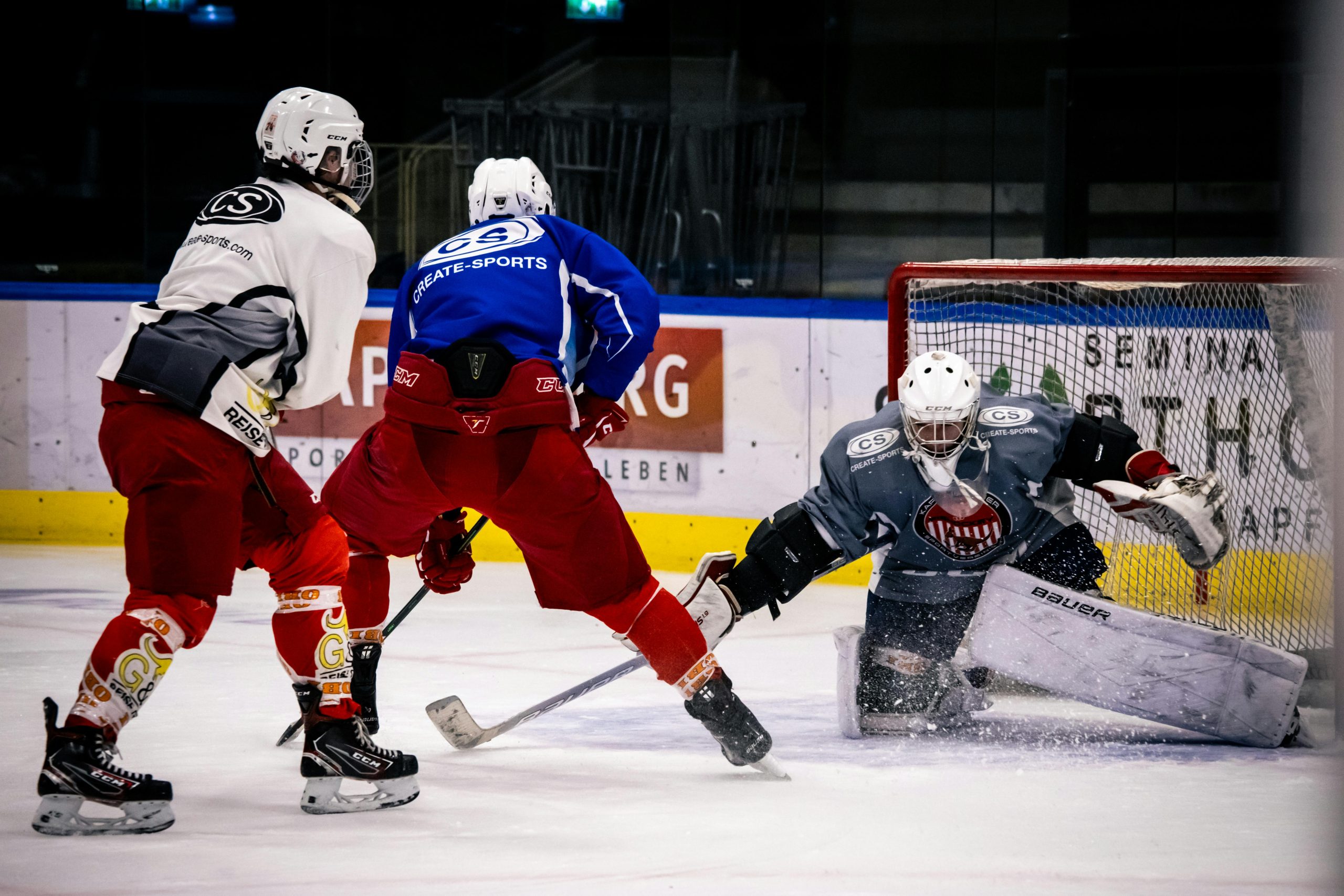
A defenseman retrieves the puck behind his own net.
One pass breaks the first line of pressure.
Another sends a winger accelerating through the neutral zone.
The puck crosses the blue line.
A defender closes the gap.
The attacker changes direction on two steel blades, pulls the puck around a stick and fires.
A fraction of a second later, the puck is either in the net, trapped by the goaltender or already heading the other way.
That is ice hockey.
It is skating, skill, speed, power, anticipation and controlled chaos compressed onto a sheet of ice.
And while hockey remains culturally inseparable from Canada and deeply established across the northern United States and Europe, its international footprint extends much farther.
The International Ice Hockey Federation currently has 84 member national associations, including countries stretching from traditional powers such as Canada, the United States, Sweden, Finland and Czechia to developing hockey nations across Asia, the Middle East, Latin America and Africa.
At the professional level, the National Hockey League operates 32 clubs and features players from more than 20 countries. The league says its games and content reach fans worldwide through an enormous international media and digital ecosystem.
Women’s professional hockey is expanding rapidly as well. The Professional Women’s Hockey League is growing to 12 teams for the 2026–27 season, adding Detroit, Hamilton, Las Vegas and San Jose to its eight existing markets.
Ice hockey is already a major global sport.
But its next chapter may be about making that global footprint even wider.
Did You Know?
Ice hockey actually made its Olympic debut before the first Olympic Winter Games existed.
The sport debuted at the 1920 Summer Olympics in Antwerp, Belgium, before becoming a permanent Winter Olympic sport beginning with Chamonix 1924.
Women’s ice hockey joined the Olympic program at Nagano in 1998.
By the Numbers
| Ice Hockey Market Indicator | Snapshot |
|---|---|
| International governing body | International Ice Hockey Federation |
| IIHF member national associations | 84 |
| IIHF founded | 1908 |
| NHL clubs | 32 |
| NHL player nationalities | 20+ countries represented |
| PWHL teams for 2026–27 | 12 |
| Hockey Canada 2025–26 registration | 615,000+ players |
| Olympic debut | Antwerp 1920 |
| First Winter Olympics appearance | Chamonix 1924 |
| Women’s Olympic debut | Nagano 1998 |
| Regulation game | Three 20-minute periods |
| Players normally on ice per team | Five skaters + goaltender |
The international governing structure alone illustrates hockey’s reach. The IIHF administers a championship program spanning its 84 member associations and multiple age and gender categories.
Meanwhile, Hockey Canada reported more than 615,000 registered players during the 2025–26 season, its fifth consecutive season of registration growth.
Watch Ice Hockey in Action
Ice hockey is one of those sports where watching elite competition can teach you more in five minutes than reading twenty pages of rules.
Do not just follow the puck.
Watch what happens away from it.
Watch defenders control gaps.
Watch forwards accelerate into open space.
Notice how quickly players transition from offense to defense.
Watch a goaltender track the puck through traffic.
Then notice how often players make decisions before the puck even reaches them.
Official places to start
NHL
The world’s most commercially powerful professional ice hockey league provides highlights, games, statistics, player features and extensive video coverage.
Official NHL YouTube Channel
One of the easiest ways for a new fan to experience elite hockey. Watch game highlights, spectacular goals, goaltending saves, skills and behind-the-scenes features.
IIHF
The best starting point for international hockey, including World Championships, Olympic competition, junior hockey and women’s international tournaments.
PWHL
Follow many of the world’s best women’s hockey players competing in a rapidly expanding professional league.
What Is Ice Hockey?
Ice hockey is a team sport played on an enclosed ice rink.
Two teams attempt to score by using hockey sticks to propel a hard rubber puck into the opponent’s goal.
A team normally has six players on the ice:
- Goaltender
- Two defensemen
- Three forwards — center, left wing and right wing
Players wear skates and move across the ice while passing, shooting, checking, defending and attempting to maintain possession of the puck.
Regulation international hockey is played over three 20-minute periods, with the team scoring the most goals winning the game.
The basic objective could hardly be simpler.
Getting good at accomplishing it is extraordinarily difficult.
Understanding the Ice
To understand hockey, it helps to understand the rink.
The playing surface is divided into three primary zones.
Defensive Zone
The area containing your own team’s goal.
Players attempt to recover possession, protect dangerous scoring areas and move the puck safely out of the zone.
Neutral Zone
The middle portion of the rink.
Transition play becomes critical here.
Teams attempt to move through the neutral zone with speed while preventing opponents from doing the same.
Offensive Zone
The area containing the opponent’s goal.
This is where teams attempt to establish possession and generate scoring opportunities.
The blue lines separating these zones are fundamental because they are tied to hockey’s offside rule.
The red line running through center ice helps divide the rink and plays a role in icing situations.
Once fans understand zones, offside and icing, the structure of hockey becomes much easier to follow.
The Positions
Every position demands skating ability, but each has different responsibilities.
Center
Centers often operate in the middle of the action.
They take faceoffs, support defense, distribute the puck and help create offense.
Great centers combine skating with awareness.
They constantly read what is developing around them.
Wingers
Left and right wings provide speed, forechecking pressure, shooting and offensive creativity.
Some are pure scorers.
Others are playmakers.
Others build careers through defensive responsibility, puck retrieval and physical play.
Defensemen
Defensemen protect their own zone but modern hockey demands far more than simply stopping attackers.
Elite defensemen must:
- Skate backward at speed
- Control gaps
- Move the puck under pressure
- Make accurate breakout passes
- Support the attack
- Defend around the net
- Read developing plays
Many of today’s best defensemen effectively become additional attackers when their teams have possession.
Goaltender
The goaltender occupies one of the most specialized positions in sports.
Goalies must track a small puck traveling at extraordinary speed while players screen their vision, redirect shots and attack from changing angles.
Technique matters.
Positioning matters.
Reflexes matter.
But anticipation may matter most.
Elite goaltending is as much about understanding what might happen next as reacting to what has already happened.
Why People Love Playing Ice Hockey
Hockey creates sensations that are difficult to reproduce in other sports.
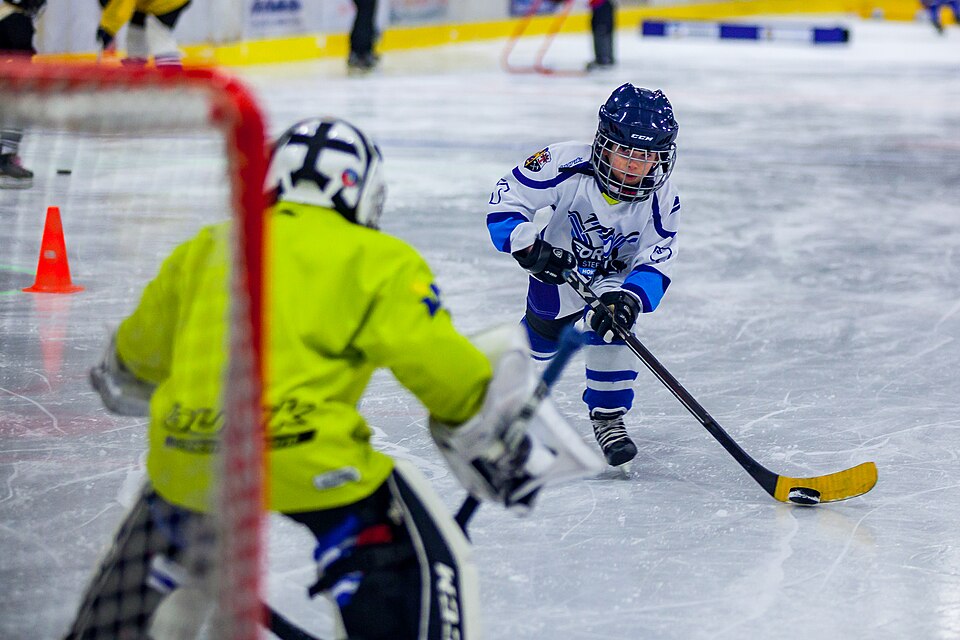
Skating itself is part of the attraction.
Once players learn to use their edges, acceleration and momentum, the ice stops feeling like an obstacle and starts feeling like an advantage.
Then add the puck.
Suddenly players can:
carry it at speed,
pass across the rink,
change direction,
shoot,
deceive defenders,
and combine with teammates without ever stopping.
That creates an unusual feeling of movement and freedom.
Hockey also rewards different kinds of athletes.
Some players dominate through speed.
Some through strength.
Some through vision.
Some through shooting.
Some through defensive intelligence.
Some through relentless effort.
And because players change in short shifts, they repeatedly attack the game at high intensity.
That creates one of hockey’s defining characteristics:
When you are on the ice, you are almost always involved.
How Athletes Become Great Ice Hockey Players
Great hockey players are built through the interaction of technical skill, skating, tactical intelligence, physical development and enormous repetition.
Skating
Everything begins here.
Players develop:
- Forward stride
- Backward skating
- Edge control
- Crossovers
- Acceleration
- Stops and starts
- Tight turns
- Transitions
- Lateral movement
- Balance under contact
A player can have extraordinary puck skills, but if they cannot reach the right place at the right time, those skills become much less valuable.
Puck Control
Players learn to control the puck while skating at speed and while processing pressure from opponents.
Advanced players can protect the puck, change its position around their body and manipulate defenders without constantly looking down.
Passing
Great hockey teams move the puck faster than defenders can move themselves.
Players therefore develop:
- Forehand passes
- Backhand passes
- Saucer passes
- One-touch passing
- Breakout passing
- Cross-ice passing
- Passing under pressure
Shooting
Players use several shooting techniques depending on time, distance and position.
These include wrist shots, snapshots, slap shots, backhand shots, one-timers and deflections.
At elite levels, release speed can be as important as raw shot power.
Hockey IQ
This is where advanced hockey separates itself.
Great players anticipate.
They understand:
where pressure is coming from,
where teammates will move,
where open ice will appear,
when to attack,
when to delay,
and when the safest play is the smartest play.
The Athlete Development Pathway
There is no single global hockey pathway.
In established markets, however, development often resembles:
Learn to Skate → Youth Hockey → Competitive/Travel Hockey → Junior or Scholastic Hockey → College/Major Junior/Elite Development → Professional or National Team
In the United States, USA Hockey provides the national development framework and represents more than one million players, coaches, officials, parents and volunteers across the broader American hockey community.
In Canada, Hockey Canada works through its member branches and development programs from grassroots participation through national teams and international competition.
Other major hockey countries operate their own federation, club and academy systems.
That diversity is one of hockey’s strengths.
A player from Minnesota may follow a different route than one from Ontario.
A Finnish player may develop through a professional club academy.
A Swedish player may enter an elite club development structure.
A Czech player may emerge through another pathway entirely.
Different systems.
Same destination.
Elite hockey.
A Sport Shaped by More Than a Century of International Competition
Modern ice hockey developed from stick-and-ball games played on ice, with Canada playing an especially important role in shaping the organized version of the sport.
International organization accelerated during the early twentieth century.
The IIHF was founded in Paris in 1908, originally as the Ligue Internationale de Hockey sur Glace.
Belgium, France, Great Britain, Switzerland and Bohemia formed the early international organization.
Then came the Olympics.
The 1920 Antwerp tournament brought Canada and the United States into international Olympic competition.
Canada’s Winnipeg Falcons won the first Olympic gold.
By 1924, hockey had moved into the inaugural Olympic Winter Games.
International rivalries eventually became some of the sport’s greatest stories:
Canada versus the Soviet Union.
Canada versus the United States.
Sweden versus Finland.
Czechia versus Slovakia.
International hockey developed its own identity alongside professional club hockey.
That dual structure remains one of the sport’s greatest strengths.
Fans can care deeply about a club for most of the year and then suddenly become completely invested in a national team.
Global Growth Analysis
Ice hockey presents an unusual global sports-market profile.
It is simultaneously enormous and geographically constrained.
In its strongest markets, hockey is deeply embedded in sporting culture.
But the sport faces a fundamental barrier that soccer, basketball and running do not:
you need ice.
And creating ice is expensive.
Rinks require:
- Refrigeration
- Significant energy
- Specialized maintenance
- Ice-resurfacing equipment
- Boards and glass
- Locker rooms
- Safety systems
- Skilled facility operators
Players also require substantial equipment.
That makes hockey harder to introduce into new markets than sports requiring only a ball and open space.
Yet the IIHF’s 84-member footprint demonstrates that those barriers have not prevented international expansion.
The growth opportunity therefore lies less in making hockey universally accessible overnight and more in building sustainable hockey centers.
One rink can become the foundation for:
youth programs,
adult leagues,
school hockey,
national-team development,
figure skating,
public skating,
tournaments,
training camps,
retail,
and community events.
That makes the rink itself an important piece of sports infrastructure.
Where Is Ice Hockey Strongest — and Where Can It Grow?
Canada
Few relationships between a country and a sport are stronger than Canada and hockey.
Hockey exists at nearly every level of Canadian sporting culture, from community rinks and minor hockey to junior leagues, universities, professional teams and national-team competition.
More than 615,000 players were registered in Hockey Canada-sanctioned programs during the 2025–26 season.
Canada remains one of the sport’s most important participation, talent-development, media and commercial markets.
United States
American hockey has developed far beyond its traditional northern markets.
The NHL’s geographic expansion helped create hockey cultures in places that once seemed unlikely destinations for elite ice hockey.
Youth development has expanded with it.
USA Hockey now supports a national ecosystem spanning all 50 states.
College hockey provides another major pathway, while professional franchises create local visibility and youth participation opportunities.
Nordic Europe
Sweden and Finland are two of the world’s great hockey nations.
Their importance goes beyond national-team success.
Both countries operate sophisticated club development systems capable of producing elite players for domestic leagues, European competition, international teams and the NHL.
Hockey is deeply integrated into their sporting cultures.
Central Europe
Czechia, Slovakia, Switzerland and Germany provide another major hockey corridor.
Strong domestic leagues, national-team traditions, passionate supporters and development structures give hockey significant commercial and cultural relevance.
The Champions Hockey League provides a cross-border club competition connecting many of Europe’s leading hockey markets.
The 2026–27 CHL features 24 clubs, including teams from Sweden, Finland, Switzerland, Germany, Czechia and several additional European leagues.
Asia
Japan, China and Korea have established hockey infrastructure, while other Asian countries continue developing national programs.
The challenge is scale.
The opportunity is population.
If hockey can build concentrated participation centers around sustainable rink infrastructure, Asian markets offer significant long-term potential.
Emerging Hockey Nations
The IIHF membership list now includes countries such as India, Indonesia, Iran, Kuwait, Malaysia, Mexico, Mongolia, Nepal, Philippines, Qatar, Singapore, Thailand, United Arab Emirates and others far beyond hockey’s traditional cold-weather heartland.
That does not mean hockey has become mainstream in these countries.
It means the infrastructure for organized international participation exists.
That is the starting point from which markets grow.
Women’s Ice Hockey: One of the Sport’s Biggest Growth Stories
Women’s hockey may represent the most important commercial expansion opportunity in the sport.
For decades, elite women’s hockey had strong international competition without an equally stable professional club ecosystem.
That is changing.
The PWHL has created a centralized professional platform featuring many of the world’s best players.
And the league is expanding aggressively.
After operating with eight teams during 2025–26, the PWHL is adding:
Detroit
Hamilton
Las Vegas
San Jose
for the 2026–27 season, creating a 12-team league.
Las Vegas is particularly interesting.
It represents another test of whether elite hockey can build passionate audiences in warm-weather markets when the product, arena experience and local investment are strong.
Women’s hockey also received another enormous global showcase at Milano Cortina 2026, where the United States defeated Canada for Olympic gold and Switzerland earned bronze.
The professional and international sides of the women’s game can now reinforce each other.
Olympic stars become professional stars.
Professional teams create local fan bases.
Local visibility inspires young players.
Young players expand participation.
Participation creates future talent.
That is how a sports ecosystem compounds.
The Business of Ice Hockey
Ice hockey is much more than a professional league.
It is an interconnected sports economy.
International Governance
International Ice Hockey Federation — IIHF
The IIHF governs international ice hockey, oversees the international rulebook and operates World Championship competition across men’s, women’s and junior categories.
Its 84 member associations provide the organizational backbone for hockey’s international footprint.
Professional Hockey
Founded in 1917, the NHL has 32 member clubs and represents the commercial pinnacle of professional ice hockey.
The league’s international player base and worldwide media distribution make it one of North America’s most globally connected professional sports properties.
Professional Women’s Hockey League — PWHL
The PWHL has quickly become the leading professional platform in women’s hockey and will operate with 12 teams beginning in 2026–27.
The CHL connects elite European clubs in an international club competition and provides another important commercial property outside North America.
Its ownership structure includes shareholder clubs, six shareholder leagues and the IIHF.
Equipment and Manufacturers
Ice hockey supports one of the most specialized equipment markets in team sports.
A player may require:
- Skates
- Stick
- Helmet
- Gloves
- Shoulder pads
- Elbow pads
- Hockey pants
- Shin guards
- Neck protection
- Base layers
- Jersey
- Socks
- Equipment bag
Goaltenders require an even more specialized equipment package.
That creates substantial economic activity across manufacturing, retail, customization, repair and replacement.
Bauer Hockey
Bauer is one of hockey’s most recognizable equipment manufacturers, producing skates, sticks, helmets, protective equipment, goalie equipment and training products.
CCM Hockey
CCM is another major global hockey equipment brand with products across skates, sticks, protective equipment, helmets, apparel and goaltending.
Warrior Hockey
Warrior produces sticks, protective equipment, helmets, gloves, goalie equipment and other hockey products used across multiple levels of the game.
TRUE Hockey
TRUE participates in the performance hockey market through sticks, skates, protective equipment and goalie products.
Equipment is not simply a side market in hockey.
It is part of the sport’s identity.
Players debate stick flex.
Blade patterns.
Skate profiles.
Sharpening.
Helmet fit.
Glove feel.
Goalie pads.
Even the way a stick is taped can become personal.
That relationship between athlete and equipment creates unusually strong brand loyalty.
The Rink Economy
Hockey also creates a business category that many field and court sports do not:
the ice rink itself.
Rinks generate economic activity through:
public skating,
youth hockey,
adult recreational leagues,
figure skating,
tournaments,
camps,
private lessons,
skills training,
equipment shops,
food and beverage,
advertising,
sponsorship,
and facility rentals.
In mature hockey communities, the rink becomes more than infrastructure.
It becomes a gathering place.
Parents spend mornings there.
Children grow up there.
Adult players return there after work.
Teams travel there for tournaments.
That community attachment gives hockey facilities significant strategic importance to the broader sports ecosystem.
Media, Data and Technology
Modern hockey is increasingly technology-driven.
At elite levels, organizations use video, tracking and analytics to evaluate:
- Zone entries
- Zone exits
- Shot locations
- Expected goals
- Passing networks
- Puck possession
- Player deployment
- Matchups
- Goaltender tendencies
- Special teams
- Skating movement
Video-analysis platforms allow coaches to break down shifts almost immediately.
Player and puck tracking can generate increasingly detailed performance data.
Equipment companies use advanced materials and manufacturing techniques to reduce weight and optimize performance.
Training technology allows players to practice shooting and stickhandling away from the rink.
Even ice-making technology matters.
For a sport whose playing surface must literally be manufactured, technology has always been part of the business.
Major Ice Hockey Competitions
Olympic Winter Games
The Olympics remain one of hockey’s most important global stages.
Men’s hockey has been part of the Winter Games since 1924, following its Olympic debut in 1920.
Women’s hockey joined in 1998.
The 2026 Olympic tournaments in Italy again demonstrated the sport’s ability to generate major international attention, with the United States winning both the men’s and women’s gold medals.
IIHF Ice Hockey World Championship
The annual men’s World Championship is one of international hockey’s signature competitions.
The championship brings national teams together annually and remains particularly important across European hockey markets.
IIHF Women’s World Championship
The women’s championship provides annual elite international competition and has become increasingly important as the women’s game expands.
IIHF World Junior Championship
The World Juniors have become one of hockey’s premier showcases for elite young talent.
The tournament provides fans, scouts and professional organizations with an early look at players who may become future international and NHL stars.
Stanley Cup Playoffs
The Stanley Cup Playoffs represent the pinnacle of professional club hockey.
The combination of best-of-seven series, physical intensity, rivalries and the history attached to the Stanley Cup makes the postseason one of hockey’s defining spectacles.
Walter Cup Playoffs
The Walter Cup provides the championship destination for the rapidly expanding women’s professional game.
Champions Hockey League
The CHL gives leading European clubs the opportunity to compete beyond their domestic leagues.
Why the Olympics Matter So Much to Hockey
Professional leagues can build enormous audiences.
But the Olympics do something different.
They expose a sport to people who may never deliberately search for it.
Someone who does not follow the NHL may watch Canada play Sweden.
Someone who has never watched women’s professional hockey may discover a star during an Olympic semifinal.
A child in a developing hockey country may see their national team and suddenly understand that the sport belongs to them too.
Olympic hockey also connects different hockey cultures.
North American stars meet European stars.
Professional teammates become international opponents.
Domestic rivalries become national ones.
For established hockey nations, Olympic medals carry enormous prestige.
For developing hockey countries, Olympic qualification itself can become a national sporting objective.
That makes the Olympics not simply another tournament.
They are part of hockey’s global development engine.
The Future of Ice Hockey
Ice hockey does not need to become soccer to succeed globally.
Its opportunity is different.
The sport already has powerful professional leagues, established international competitions, major equipment manufacturers, Olympic prestige and some of the world’s most passionate sports communities.
Its challenge is widening the map.
Several forces could shape that future.
Women’s Professional Hockey
The expansion of the PWHL gives women’s hockey something it has long needed: a growing professional club structure capable of building local fan relationships between international tournaments.
International Rink Development
New facilities can create concentrated hockey communities in markets where natural ice is irrelevant.
Modern hockey no longer needs winter weather.
It needs infrastructure.
Digital Distribution
Highlights are perfect for digital sports consumption.
A spectacular goal, impossible save or open-ice rush can be understood almost instantly.
That makes hockey highly shareable.
International Professional Exposure
The NHL continues taking regular-season games outside North America.
Its 2026 Global Series includes games in Finland and Germany, continuing the league’s strategy of bringing NHL competition directly to European audiences.
New Markets
The growth of hockey in places without traditional winter climates remains one of the sport’s most intriguing possibilities.
Las Vegas has already demonstrated that desert geography does not prevent professional hockey from developing a market.
The same principle can apply elsewhere.
The question is not:
Does this place have frozen ponds?
The modern question is:
Can this market support a rink, a community and a hockey culture?
That dramatically expands what is possible.
Global Sports Market Index
| Market Factor | Score | Global Sports Market View |
| Participation Potential | 9/10 | Strong established participation with room for international development |
| Global Reach | 9/10 | Major North American and European presence with an 84-nation IIHF footprint |
| Accessibility | 6/10 | Rinks and equipment create significant cost and infrastructure barriers |
| Spectator Appeal | 10/10 | Speed, scoring, physicality and constant action create exceptional live appeal |
| Professional Ecosystem | 10/10 | NHL, PWHL and major European leagues provide extensive professional infrastructure |
| Youth Development | 10/10 | Sophisticated development systems exist throughout major hockey nations |
| Women’s Growth Opportunity | 10/10 | PWHL expansion and international visibility create enormous potential |
| Commercial Potential | 10/10 | Leagues, media, equipment, facilities, events and training create multiple revenue markets |
| Olympic Opportunity | 10/10 | One of the signature team sports of the Olympic Winter Games |
| Discovery Value | 10/10 | Visually spectacular and immediately compelling for new spectators |
| Overall | 94/100 | Global Power Sport |
Global Sports Market Intelligence Rating
94 / 100
Classification: Global Power Sport
Ice hockey’s biggest weakness is obvious.
It is expensive to build the environment required to play it.
But once that environment exists, remarkably deep ecosystems can form around it.
Youth participation.
Adult recreation.
Professional teams.
Equipment.
Training.
Media.
International competition.
Arena operations.
Events.
Tourism.
Sponsorship.
Merchandise.
And passionate multi-generational fan communities.
That combination makes hockey much larger than the number of countries where it currently operates as a mainstream sport might suggest.
Final Thoughts
Ice hockey asks athletes to do something difficult before the game even begins.
Learn how to move on ice.
Then it asks them to do it faster.
While controlling a puck.
While reading teammates.
While avoiding opponents.
While absorbing contact.
While making decisions in fractions of a second.
That difficulty is part of what makes the sport extraordinary.
When elite hockey players move across the ice, the game can almost appear effortless.
It is anything but.
Behind every smooth breakout, one-timer, glove save and perfectly timed defensive play are thousands of hours spent learning how to make an unnatural environment feel completely natural.
And that may explain why hockey inspires such devotion.
People do not simply watch the game.
In its strongest communities, they grow up inside it.
Now the sport is attempting to build more of those communities around the world.
Global Sports Market Verdict
Market Position: Major global winter sport with an elite professional and international ecosystem
Accessibility: Challenging because of rink infrastructure, equipment requirements and participation costs
International Reach: Strong across North America and Europe with meaningful development across additional global markets
Commercial Ecosystem: Exceptional across professional leagues, equipment, facilities, media, events, training and sponsorship
Women’s Growth Opportunity: Outstanding, with the rapidly expanding PWHL creating a stronger professional pathway
Olympic Value: Exceptional
Discovery Value: Exceptional
Editorial Verdict
Ice hockey is one of the world’s great sports products.
The speed is real.
The skill is extraordinary.
The physicality is unmistakable.
The atmosphere can be spectacular.
And the commercial ecosystem surrounding the game is mature enough to support everything from billion-dollar professional organizations to neighborhood youth programs.
Its greatest constraint — the need for expensive ice infrastructure — is also what makes each successful hockey market so valuable.
Once a rink exists and a community forms around it, hockey can become deeply rooted.
That is why the most interesting question surrounding the sport is not whether ice hockey can remain powerful in Canada, the United States, Scandinavia and Central Europe.
It can.
The bigger question is how many more hockey communities can be created beyond those traditional strongholds.
With 84 IIHF member associations, expanding women’s professional hockey, continued Olympic exposure and professional leagues increasingly looking internationally, the foundation already exists.
Global Sports Market Intelligence Rating: 94/100
Explore the Sport
International Ice Hockey Federation — IIHF
The international governing body and essential gateway into global hockey. Explore national associations, international rankings, World Championships, Olympic hockey, rules and development resources.
IIHF Member National Associations
Explore the sport country by country through the IIHF’s 84 member national associations. This is one of the best resources for understanding how far organized hockey extends around the world.
National Hockey League — NHL
The leading professional ice hockey league in North America and one of the sport’s most important global media and commercial properties.
Professional Women’s Hockey League — PWHL
Follow the rapidly expanding professional women’s game, including teams, players, schedules, standings, video and the Walter Cup.
Champions Hockey League
Explore elite European club hockey and see how leading teams from multiple domestic leagues compete internationally.
Hockey Canada
Canada’s national governing body provides national-team coverage, grassroots development information, coaching resources, programs and pathways into the game.
USA Hockey
The U.S. national governing body provides youth development, coaching, officiating, national-team and participation resources across American hockey.
Official NHL YouTube Channel
A strong starting point for new fans who want to see the speed and skill of professional hockey through official highlights and features.
IIHF Development Hub
The IIHF provides development and educational resources designed to help national associations, clubs and other stakeholders organize and grow hockey programs.
Continue Your Global Sports Discovery Journey
If ice hockey caught your attention, continue exploring sports that share its relationship with ice, speed, movement and winter competition.
Discover Figure Skating
Explore another ice-based Olympic sport where edge control and skating technique are transformed into an extraordinary combination of athleticism, precision and artistry.
Discover Speed Skating
Discover what happens when skating is stripped down to one essential objective — becoming the fastest athlete on the ice.
Discover Curling
Explore a completely different way to compete on ice, where precision, sweeping, strategy and team communication replace hockey’s speed and physicality.
Discover Alpine Skiing
Move from the rink to the mountain and explore another iconic winter sport built around speed, edge control, courage and split-second decision-making.
Continue Your Global Sports Discovery
The world of sports is much bigger than the games most of us grew up watching.
Across hundreds of sports, athletes are competing, communities are growing, businesses are being built and new fans are discovering something extraordinary for the first time.
Ice hockey shows exactly why exploring that wider world matters.
A sport can begin in cold-weather communities, build powerful traditions across generations and eventually create professional leagues, international championships and passionate audiences thousands of miles from where the game first developed.
And there are hundreds more sports stories waiting to be discovered.
Explore more Global Sports Market Intelligence Reports at theGLOBALSPORTSMARKET.com.
Discover the sports. Understand the markets. Explore the opportunities.
Published By
theGLOBALSPORTSMARKET.com
A KODA8, LLC Property
Powered by theGLOBALMARKET.ai

Author: theHowie
We are building a network of digital resources designed to bring some much-needed order to the internet's most chaotic corners. I don't just collect domains; I build them into authoritative hubs for the topics I’m passionate about.