

Few sports make less sense the first time you see them.
An athlete points a pair of skis down a massive ramp, accelerates toward the edge, launches into open air and tries to fly as far as possible before landing gracefully on a steep hillside.
That is ski jumping.
What looks like pure courage is actually a highly technical competition built around speed, aerodynamics, balance and precision. And in countries including Norway, Germany, Austria, Poland and Japan, ski jumping is much more than an Olympic curiosity.
It is one of winter sport’s great traditions.
Quick Facts
Sport: Ski Jumping
International Governing Body: International Ski and Snowboard Federation (FIS)
Major Competition: FIS Ski Jumping World Cup
Olympic Sport: Yes
Olympic Debut: 1924
Primary Markets: Europe and Japan
Competition Types: Normal Hill, Large Hill and Ski Flying
Market Stage: Established
Best Known For: Athletes appearing to fly enormous distances through the air
Watch Ski Jumping
The concept is wonderfully simple.
Get down the ramp. Take off. Fly. Land.
But virtually everything between those steps is technical.
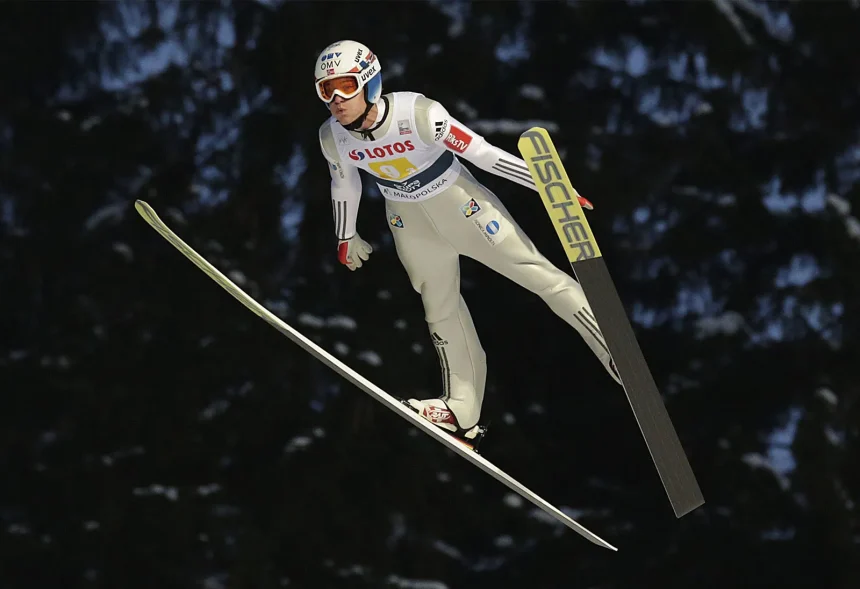
Jumpers accelerate down the inrun in a compact aerodynamic position before exploding from the takeoff table. Once airborne, they spread their skis into the familiar V-style, using their bodies and equipment to generate lift.
Judges don’t simply measure distance.
Competition scores combine the length of the jump with style scores, while wind and starting-gate adjustments help account for changing conditions.
The result is a sport where a few centimeters of body position can separate a spectacular jump from an average one.
By the Numbers
Ski jumping has been part of every Winter Olympic Games since 1924.
Women’s ski jumping joined the Olympic program in 2014, and the mixed-team competition debuted in 2022.
The 2026 Milano Cortina Games expanded the Olympic program again by adding women’s large hill, producing six ski jumping medal events.
In the United States, the sport remains relatively small but has an established development network. USA Ski Jumping reports more than 30 clubs and 700+ youth participants within its development system.
At the other end of the spectrum is ski flying, where the world’s largest hills allow elite athletes to travel well beyond 200 meters.
That’s more than two football fields through the air.
The Athlete Experience
Ski jumping demands an unusual combination of abilities.
Athletes need explosive leg power for takeoff, exceptional balance, flexibility, coordination and extraordinary control while traveling through the air.
Weight and equipment are also closely regulated because aerodynamics matter enormously.
The jumping suit itself affects airflow. Ski length, bindings, boots and equipment configuration are governed by detailed FIS regulations designed around both competitive fairness and athlete safety.
Then there is the mental component.
Standing above a ski jump and voluntarily pushing away from the starting bar requires something that cannot easily be measured:
commitment.
Once the jumper starts moving, there is no timeout.
Fan Appeal
Ski jumping has one enormous advantage as a spectator sport:
You don’t need to understand it to know when you’ve seen something incredible.
The athlete leaves the ramp.
The crowd watches the flight.
The distance appears.
The judges score the landing.
That simplicity makes ski jumping particularly effective during the Winter Olympics, when millions of casual viewers encounter sports they rarely watch during the rest of the year.
For established fans, however, another layer emerges.
Wind direction, gate position, takeoff timing, ski position and landing technique can dramatically change the outcome.
Simple on the surface.
Highly technical underneath.
Global Footprint
Ski jumping’s center of gravity remains Europe.
Norway has deep historical ties to the sport, while Austria, Germany, Poland and Slovenia have developed passionate fan bases and strong competitive programs.
Japan represents one of ski jumping’s most important markets outside Europe.
Japanese athletes have produced some of the country’s most memorable Winter Olympic moments, including a sweep of the men’s normal-hill medals at the 1972 Sapporo Games and team gold at Nagano in 1998.
The United States, Finland, Switzerland and several other winter-sport nations also maintain competitive programs.
Where It’s Growing
One of ski jumping’s biggest opportunities is the continued development of the women’s sport.
Women’s ski jumping did not make its Olympic debut until 2014.
A mixed-team event followed in 2022.
Women’s large hill was then added for Milano Cortina 2026.
That progression creates additional elite competition opportunities, media inventory and development pathways for female athletes.
Modern artificial surfaces also allow some ski jumping facilities to operate outside the traditional winter season, creating additional training and competition opportunities.
Youth & Development
Ski jumping has an obvious barrier that soccer, basketball and running do not:
You need a ski jump.
That makes local clubs extremely important.
Young athletes generally begin on small training hills rather than anything resembling the enormous structures seen at the Olympics.
Development systems gradually introduce larger hills as athletes improve their technique and confidence.
USA Ski Jumping’s development program specifically supports youth recruitment, clubs, coaching education, athlete pathways and grassroots programming.
For families interested in the sport, the best starting point is usually finding the nearest established ski jumping club.
Business of Ski Jumping
Ski jumping is an interesting sports business because its infrastructure is both its greatest limitation and one of its greatest assets.
Large ski jumps are expensive, specialized venues.
But iconic facilities can also become recognizable landmarks and tourism destinations.
At the elite level, the sport supports an ecosystem involving:
- Event sponsorship
- Television and streaming rights
- Tourism
- Equipment manufacturers
- Ski resorts and winter destinations
- National federations
- Athlete sponsorships
- Hospitality and major-event hosting
The FIS World Cup provides the sport’s primary annual international competition circuit, while the Olympics and World Championships create its largest global showcases.
The sport is therefore concentrated geographically—but can be extremely valuable in markets where ski jumping has an established audience.
Equipment & Technology
Few sports demonstrate the relationship between equipment and human performance as clearly as ski jumping.
A jumper uses specialized:
Jumping skis — significantly longer and wider than conventional alpine skis.
Bindings — designed to allow the heel to rise while keeping the athlete connected to the ski.
Boots — built specifically for jumping position and control.
Jumping suit — tightly regulated because even subtle differences can affect aerodynamic performance.
Helmet and goggles — essential protective equipment.
Technology and regulation constantly interact.
FIS maintains detailed equipment specifications covering skis, bindings, suits and other equipment, and equipment-control officials are part of the competitive structure.
In ski jumping, aerodynamics aren’t a side issue.
They are part of the sport.
Global Sports Market Index
Global Reach — 7/10
Strong international competition but concentrated primarily in winter-sport nations.
Participation Accessibility — 3/10
Specialized facilities create a major barrier to participation.
Fan Appeal — 9/10
One of the most instantly spectacular winter sports.
Youth Development — 6/10
Strong club systems exist in established markets, but geography matters enormously.
Commercial Potential — 7/10
Strong sponsorship, broadcasting and tourism potential in core markets.
Media Value — 8/10
Highly visual and extremely well suited to television and digital highlights.
Olympic Importance — 9/10
Part of every Winter Olympics since the inaugural Games in 1924.
Growth Potential — 6/10
Women’s competition and improved year-round training provide opportunities, although infrastructure limits global expansion.
Global Sports Market Index: 55/80
Intelligence Rating
Established
Ski jumping is not a globally accessible participation sport, and it probably never will be.
That isn’t necessarily a weakness.
Its value comes from somewhere else.
Ski jumping combines Olympic history, spectacular television, national sporting traditions and one of the most distinctive experiences in all of athletics.
In its strongest markets, it isn’t unusual.
It’s part of winter.
Did You Know?
Modern ski jumping was transformed by the V-style.
Instead of keeping the skis parallel during flight, jumpers angle them outward into a V.
The technique produces greater aerodynamic lift and eventually became the standard approach used by elite jumpers around the world.
What once looked unconventional fundamentally changed how humans fly on skis.
Final Thoughts
Ski jumping occupies a fascinating place in the global sports market.
Participation will always be limited by geography and infrastructure.
Spectator appeal isn’t.
There are very few sports where the basic premise remains this compelling:
How far can a human being fly?
Ski jumping has spent generations trying to find out.
And every winter, athletes climb back to the top of the hill and try again.
Explore Ski Jumping
Start with the organizations and competitions that run the sport:
- FIS Ski Jumping
- FIS Ski Jumping World Cup
- Olympic Ski Jumping
- USA Ski Jumping
- USA Ski Jumping – Find a Club
Continue Your Discovery
If ski jumping caught your attention, explore more winter sports on theGLOBALSPORTSMARKET.com:
- Bobsleigh Explained: Speed, Power and Precision on Ice
- Figure Skating
- Curling
- Ice Hockey
theGLOBALSPORTSMARKET.com delivers independent intelligence on the sports, organizations, events and opportunities shaping the global sports economy.

Author: theHowie
We are building a network of digital resources designed to bring some much-needed order to the internet's most chaotic corners. I don't just collect domains; I build them into authoritative hubs for the topics I’m passionate about.