




Global Sports Market Intelligence Report
Category: Cycling Sports | Market Stage: Established Niche Sport | Global Sports Market Intelligence Rating: Hidden Gem
Discover Cycle Ball (Radball), the extraordinary indoor sport where elite athletes play soccer on custom-built bicycles. Explore its history, rules, world championships, business ecosystem, and official resources.
When Two Wheels Become the World’s Most Unexpected Playing Field
Imagine trying to score a goal while balancing on a bicycle.
Now imagine your opponent trying to steal the ball—also on a bicycle.
No brakes.
No putting your feet on the ground.
No room for mistakes.
Welcome to Cycle Ball, one of the world’s most fascinating and technically demanding sports.
Known as Radball throughout much of Europe, Cycle Ball combines elements of soccer, cycling, chess, gymnastics, and precision engineering into a competition unlike anything most sports fans have ever witnessed.
For more than 130 years, athletes have mastered this remarkable discipline, proving that innovation in sport doesn’t always require new technology—sometimes it simply requires looking at a bicycle differently.
Why Cycle Ball Matters
Every sport tells a story about creativity.
Cycle Ball reminds us that some of the world’s greatest athletic achievements happen far away from television cameras and sold-out stadiums.
Invented in the late nineteenth century, the sport has survived world wars, technological revolutions, and changing sporting tastes because it rewards something timeless: mastery.
Balance.
Precision.
Teamwork.
Strategy.
Unlike many sports that rely heavily on physical strength or speed, Cycle Ball demands complete control over both athlete and machine. Every movement is deliberate, every pass calculated, and every goal the result of extraordinary coordination.
Today, the sport continues to flourish through clubs, youth academies, national leagues, and international championships governed by the Union Cycliste Internationale (UCI), the global governing body for cycling.
For anyone who believes they’ve seen every sport imaginable, Cycle Ball is a reminder that the sporting world still holds incredible surprises.
📊 By the Numbers
| Statistic | Value |
|---|---|
| Invented | 1893 |
| Inventor | Nicholas Edward Kaufmann |
| Players | 2 per team |
| Match Length | Two 7-minute halves |
| Playing Surface | Indoor court |
| Governing Body | Union Cycliste Internationale (UCI) |
| Primary Competition | UCI Indoor Cycling World Championships |
| Strongest Nations | Germany, Austria, Switzerland, Czech Republic, Japan, Belgium |
| Bicycle Type | Custom fixed-gear Cycle Ball bicycle |
💡 Did You Know?
Cycle Ball bicycles are designed specifically for competition. Their fixed-gear drivetrain, steep frame geometry, reinforced wheels, and lack of brakes allow athletes to perform incredibly precise maneuvers that would be impossible on a standard bicycle.
How Cycle Ball Is Played
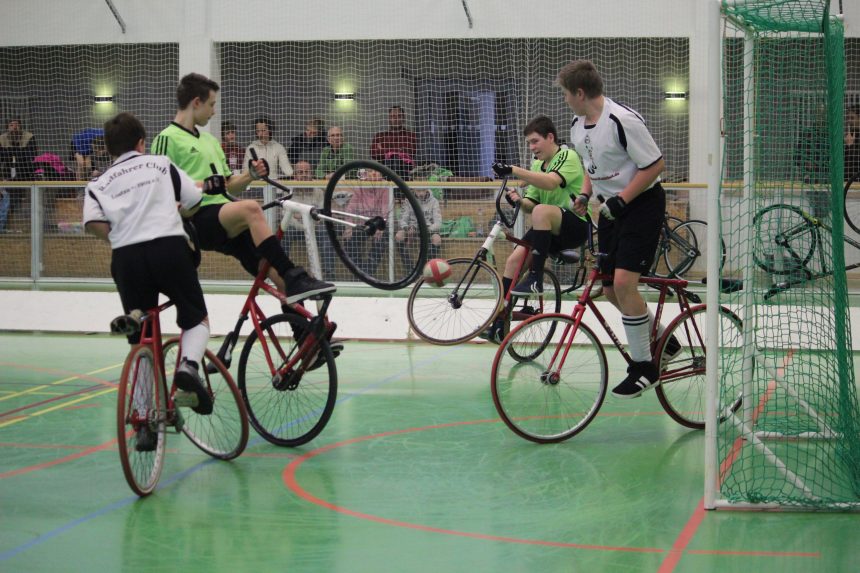
Two riders compete against two opponents on a compact indoor court.
The objective is simple:
Score more goals than the opposing team.
Everything else is extraordinary.
Players remain mounted throughout the match, using specially designed bicycles to control, pass, intercept, and shoot the ball.
Unlike soccer, players rarely use their bodies to control play. Instead, the front and rear wheels become the primary tools for dribbling and passing.
Touching the ground with a foot carries a tactical penalty, forcing the player to temporarily leave active play before re-entering from their defensive area.
Matches move quickly, with constant changes of possession demanding exceptional communication between teammates.
At the elite level, the sport resembles a carefully choreographed performance as much as an athletic contest.
A Brief History of Cycle Ball
Cycle Ball was invented in 1893 by Swiss-American artistic cyclist Nicholas Edward Kaufmann, who reportedly began experimenting with controlling a ball using the wheels of his bicycle after accidentally striking one during a ride.
The concept spread rapidly through European cycling clubs, particularly in Germany, Austria, and Switzerland, where indoor cycling already enjoyed widespread popularity.
As the sport matured, standardized rules, national championships, and international tournaments followed.
Today, Cycle Ball is one of two major disciplines within UCI Indoor Cycling, alongside Artistic Cycling, and continues to crown world champions each year.
Although relatively unknown outside its strongest regions, it has developed one of the most dedicated communities in international cycling.
Watch Cycle Ball in Action
It’s difficult to appreciate Cycle Ball until you see elite athletes in competition.
Recommended viewing includes:
- UCI Indoor Cycling Highlights
- UCI Cycle Ball World Championship Finals
- German Bundesliga Radball Matches
- Elite Cycle Ball Skills & Goals Compilations
Watching even a few minutes quickly reveals why athletes spend years mastering the sport.
The Business of Cycle Ball
Cycle Ball may be a niche discipline, but it supports a surprisingly sophisticated ecosystem.
The sport creates demand for:
- Specialized bicycle manufacturers
- Indoor sporting venues
- National cycling federations
- Youth development clubs
- Professional coaching
- Competition equipment
- Event organizers
- Officials and referees
- Sports media and livestream production
Because the bicycles are purpose-built and cannot simply be purchased at a local bike shop, a dedicated manufacturing sector has developed around the sport.
Major cycling federations in Europe continue investing in athlete development, ensuring that knowledge and participation pass from one generation to the next.
While commercial sponsorship remains modest compared with mainstream cycling disciplines, Cycle Ball demonstrates how passionate communities can sustain specialized sports for more than a century.
Explore Cycle Ball
If you’d like to continue your discovery, these official resources are the best place to start.
🌍 Official Governing Bodies
Union Cycliste Internationale (UCI)
The official international governing body for cycling, responsible for World Championships, rankings, regulations, and the future development of Cycle Ball worldwide.
UCI Indoor Cycling
https://www.uci.org/discipline/indoor-cycling
Official news, rules, competition schedules, rankings, and championship information for Cycle Ball and Artistic Cycling.
🇩🇪 National Federations
Bund Deutscher Radfahrer (Germany)
Germany has long been one of the world’s strongest Cycle Ball nations, with an extensive club system and elite competitions.
Swiss Cycling
The official governing body for cycling in Switzerland and an important supporter of indoor cycling disciplines.
Cycling Austria
https://www.radsportverband.at/
Austria continues to produce internationally competitive Cycle Ball athletes through a strong domestic club network.
📺 Watch
- UCI Indoor Cycling YouTube coverage
- UCI World Championship Highlights
- German Bundesliga Cycle Ball matches
📖 Learn More
- Official UCI Indoor Cycling Regulations
- UCI Event Calendar
- National federation club directories
Global Sports Market Index
| Category | Rating |
|---|---|
| Global Recognition | ⭐⭐☆☆☆ |
| Accessibility | ⭐⭐☆☆☆ |
| Technical Difficulty | ⭐⭐⭐⭐⭐ |
| Entertainment Value | ⭐⭐⭐⭐⭐ |
| Commercial Opportunity | ⭐⭐⭐☆☆ |
| Youth Development | ⭐⭐⭐⭐☆ |
| International Growth Potential | ⭐⭐⭐☆☆ |
| Uniqueness | ⭐⭐⭐⭐⭐ |
Final Verdict
Cycle Ball is proof that some of the world’s greatest sporting experiences remain hidden in plain sight.
Its athletes demonstrate a level of bicycle control that borders on unbelievable, while its century-long history reflects the enduring appeal of creativity, precision, and teamwork.
It may never become a household name, but that isn’t the point.
The world’s sporting culture is richer because Cycle Ball exists.
At theGLOBALSPORTSMARKET.com, our mission is to help sports fans discover those hidden gems—and Cycle Ball is exactly the kind of sport that deserves to be seen by a much larger audience.
Continue Your Discovery
If Cycle Ball captured your imagination, don’t stop here. Explore more remarkable sports that celebrate skill, teamwork, endurance, and innovation from around the world.
- 🚣 Dragon Boat Racing – Discover the ancient paddling sport that has become one of the world’s fastest-growing team competitions.
- 🧭 Orienteering – Explore the endurance sport where navigation is just as important as speed through forests, mountains, and urban landscapes. (Link to your published Orienteering article.)
- 🏓 Beyond the Basement: Why Table Tennis Is One of the World’s Biggest Sports
https://theglobalsportsmarket.com/court-sports/table-tennis/2026/beyond-the-basement-why-table-tennis-is-one-of-the-worlds-biggest-sports/
Cycle Ball is another reminder that the world’s sporting landscape extends far beyond the games most people watch every weekend. Every sport has a story, a community, and a culture waiting to be discovered.
Subscribe to theGLOBALSPORTSMARKET.com, explore our growing library of Global Sports Market Intelligence Reports, and continue your journey through the incredible world of sports—one discovery at a time.

Author: Howie
We are building a network of digital resources designed to bring some much-needed order to the internet's most chaotic corners. I don't just collect domains; I build them into authoritative hubs for the topics I’m passionate about.