




Florence Has Preserved a Sport the Modern World Could Never Invent
Imagine a ball game played by 54 athletes on a field covered in sand.
- Florence Has Preserved a Sport the Modern World Could Never Invent
- Quick Facts
- Did You Know?
- Why Calcio Storico Matters
- Watch Calcio Storico in Action
- What Is Calcio Storico?
- How Is Calcio Storico Different From Football and Rugby?
- Why People Play Calcio Storico
- By the Numbers
- The Four Teams of Florence
- How Athletes Prepare for Calcio Storico
- The History Behind the Game
- Where Is Calcio Storico Growing?
- The Business of Calcio Storico
- Could Calcio Storico Become a Global Sport?
- Global Sports Market Index
- Explore the Sport
- City of Florence — Calcio Storico Fiorentino
- Official Calcio Storico Fiorentino Website
- Feel Florence — Calcio Storico
- Visit Tuscany — Calcio Storico Fiorentino
- City of Florence — Historical Results
- City of Florence — Match Archive
- Final Thoughts
- Global Sports Market Verdict
- Continue Your Global Sports Discovery Journey
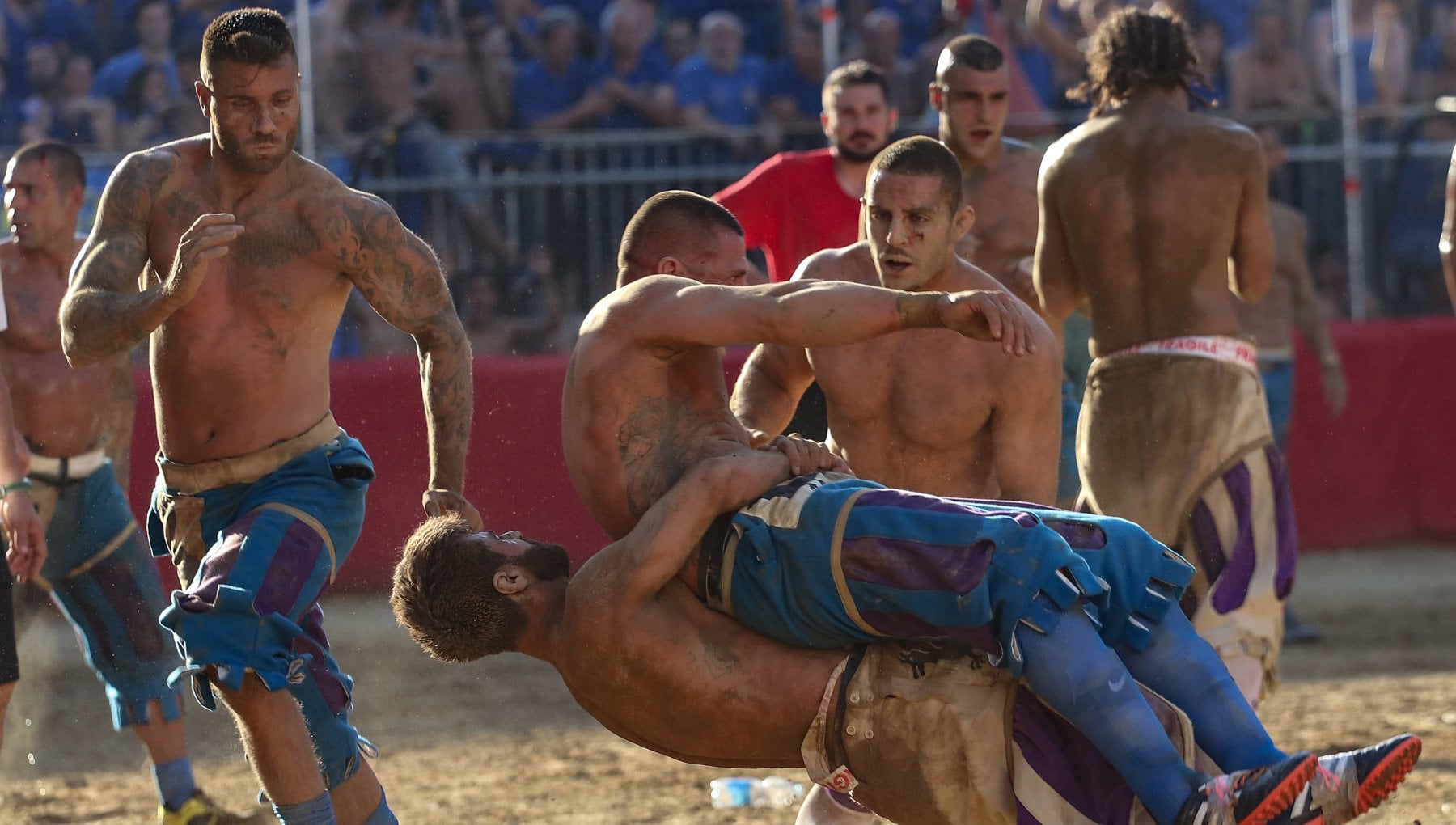
Players can run with the ball, throw it, kick it, wrestle opponents to the ground, and fight for control while thousands of spectators watch from temporary stands in one of Europe’s most historic public squares.
The players wear colorful Renaissance-inspired uniforms.
The teams represent ancient neighborhoods rather than commercial franchises.
The prize matters far less than the honor of defending a district, a family, and a city.
This is Calcio Storico Fiorentino, one of the most unusual and culturally significant sporting traditions still contested anywhere in the world.
Every June, Florence transforms Piazza Santa Croce into a temporary arena. Sand covers the square, historic banners appear, and the city’s four traditional districts compete in a sport that looks like football, rugby, wrestling, and martial arts colliding at the same time.
Calcio Storico is not a modern reconstruction created for tourists. Its documented history reaches back to Renaissance Florence, while its mythology connects it to much older Greek and Roman ball games. The modern tournament preserves that history as a living expression of Florentine identity.
Quick Facts
| Calcio Storico Fact | Details |
|---|---|
| Full Name | Calcio Storico Fiorentino |
| English Translation | Historic Florentine Football |
| Location | Florence, Italy |
| Primary Venue | Piazza Santa Croce |
| Teams | Four |
| Players | 27 per team |
| Players on the Field | 54 |
| Match Length | Approximately 50 minutes |
| Playing Surface | Sand |
| Scoring Unit | Caccia |
| Traditional Season | June |
| Cultural Classification | Historic sport and Florentine folk tradition |
| Official Authority | City of Florence |
Did You Know?
One of the most famous Calcio Storico matches was played on February 17, 1530, while Florence was under siege. According to the city’s official account, Florentines played in Piazza Santa Croce as an act of defiance toward the forces surrounding them.
Why Calcio Storico Matters
Calcio Storico matters because it shows that sports do not need global leagues, enormous television contracts, or international governing bodies to possess extraordinary value.
Its importance comes from something deeper: identity.
The competition belongs specifically to Florence. Each team represents one of the city’s four historic districts, and participation connects athletes to neighborhoods whose rivalries extend across generations.
The four teams are:
- Azzurri, representing Santa Croce
- Bianchi, representing Santo Spirito
- Rossi, representing Santa Maria Novella
- Verdi, representing San Giovanni
The colors are immediately recognizable to Florentines. They are not simply uniforms. They represent geography, community, loyalty, and local history.
In an era when many professional teams can relocate, rebrand, or change ownership, Calcio Storico remains inseparable from the place that created it.
That authenticity is its greatest strength.
Watch Calcio Storico in Action
Calcio Storico is difficult to understand until you see it.
A match can appear chaotic at first. Players wrestle across the sand while teammates attempt to create an opening for the ball carrier. Some competitors focus on advancing the ball. Others engage opponents physically to remove them from the play.
The following official resources provide event information, photographs, history, and video coverage:
- City of Florence — Calcio Storico Fiorentino
- Feel Florence — Historical Football
- Visit Tuscany — Calcio Storico Fiorentino
- Official Calcio Storico Fiorentino website
Search for recent full-match footage from the City of Florence and official Calcio Storico channels to experience the procession, atmosphere, physical intensity, and scale of the event.
What Is Calcio Storico?
Calcio Storico is a team ball game played between two teams of 27 competitors, known as calcianti.
The match takes place on a large rectangular field covered in sand. At each end is a wide scoring area protected by a net.
The objective is to move the ball into the opposing team’s net and score a caccia. Players can advance the ball with their hands or feet, creating a game that shares visible characteristics with football, rugby, handball, and combat sports.
A match lasts approximately 50 minutes. The team with the most cacce at the end wins.
There are no conventional formations comparable to modern soccer, but players traditionally assume different roles.
Some move and distribute the ball.
Others attempt to create space by engaging opposing players physically.
Because so many individual battles occur simultaneously, team coordination remains essential. Physical strength alone is not enough. A team must decide where to attack, which opponents to occupy, and when to release players into open space.
The game can be violent, but it is not simply uncontrolled fighting. It operates within an official framework administered by Florence and supported by detailed tournament regulations.
How Is Calcio Storico Different From Football and Rugby?
Calcio Storico is often described as an ancestor of modern football, although the comparison can be misleading.
The game permits athletes to use both their hands and feet. Its flowing ball movement can resemble rugby, while its physical confrontations include elements of wrestling and striking.
However, Calcio Storico developed within its own Florentine cultural environment. It should not be treated merely as an early version of another sport.
Its defining characteristics include:
- Twenty-seven players on each team
- A sand-covered playing field
- A scoring net spanning much of each end
- Extensive physical contact
- Hand and foot movement of the ball
- Matches connected to historic Florentine districts
- Renaissance-style ceremonial dress
- A historical procession preceding the competition
The surrounding ceremony is just as important as the game itself. A major procession through central Florence introduces the event and reinforces its connection to the Florentine Republic and the city’s Renaissance past.
Why People Play Calcio Storico
Calcio Storico is not a conventional professional sports career.
Players do not participate because they expect lucrative contracts or international fame. They compete because representing their district is considered a profound honor.
For many calcianti, the sport is connected to:
- Neighborhood loyalty
- Family tradition
- Florentine identity
- Personal courage
- Brotherhood
- Physical sacrifice
- Civic pride
Preparation requires significant commitment. Competitors often come from backgrounds in rugby, boxing, wrestling, mixed martial arts, strength training, or other demanding sports.
Yet athletic ability is only one requirement.
Players must also understand the emotional responsibility attached to representing one of Florence’s historic colors. The competition is intensely local, and that is precisely why it has such international appeal.
Visitors are not merely watching athletes compete. They are witnessing a city perform its own history.
By the Numbers
- 4 historic district teams
- 27 players per team
- 54 players on the field
- 50 minutes per match
- 2 semifinals
- 1 final
- 1 sand-covered Renaissance square
- Nearly 500 years since the legendary siege match of 1530
- More than 500 participants may appear in the accompanying historical procession, according to City of Florence event documents.
The Four Teams of Florence
Azzurri di Santa Croce
The Blues represent Santa Croce, the district associated with the square where the modern tournament is played.
Bianchi di Santo Spirito
The Whites represent Santo Spirito, located on the southern side of the Arno and known for its strong neighborhood identity.
Rossi di Santa Maria Novella
The Reds represent Santa Maria Novella, the district surrounding one of Florence’s most famous churches and transport gateways.
Verdi di San Giovanni
The Greens represent San Giovanni, the historic district connected to Florence’s religious and civic center.
The tournament normally consists of two semifinals followed by a final. The decisive match is traditionally connected to the celebrations for Saint John the Baptist, Florence’s patron saint, on June 24.
How Athletes Prepare for Calcio Storico
There is no universal path to becoming a Calcio Storico player.
The most effective competitors usually combine several athletic qualities:
- Functional strength
- Sprinting ability
- Grappling experience
- Striking control
- Cardiovascular endurance
- Spatial awareness
- Ball-handling ability
- Emotional discipline
- Team loyalty
Training must prepare athletes for repeated physical confrontations without losing sight of the game’s strategic objective.
A competitor who becomes absorbed in an individual battle may leave space elsewhere on the field. Successful teams understand that physical contact is a tactical tool rather than the ultimate purpose of the match.
This distinction separates organized Calcio Storico from a simple brawl.
The goal remains scoring.
The History Behind the Game
The origins of Calcio Storico are surrounded by history and legend.
Official Florentine sources connect the tradition to ancient Greek ball games and the Roman game of harpastum. More reliable documentation places forms of Florentine football in the late medieval and Renaissance periods, with written evidence appearing by the end of the 15th century.
The match that defines the sport’s identity took place on February 17, 1530.
Florence was under siege by forces connected to Emperor Charles V. Despite hunger and military pressure, Florentines organized a game in Piazza Santa Croce. The act reportedly demonstrated that the city remained unbroken and unwilling to show fear.
The match became a symbol of Florentine defiance.
Calcio Storico later disappeared from regular public life for an extended period. The official Florence tourism authority notes that the last documented historic match occurred in 1739 before the tradition was revived in 1930. Since that revival, it has continued with relatively few interruptions.
That revival transformed the sport into both a competition and a historical commemoration.
Where Is Calcio Storico Growing?
Calcio Storico presents an unusual growth story because expansion does not necessarily mean creating leagues in other countries.
The sport’s value depends heavily on its connection to Florence. Reproducing it in dozens of cities could weaken the authenticity that makes it special.
Instead, its global growth is occurring through awareness.
International audiences discover Calcio Storico through:
- Sports documentaries
- Travel programming
- Streaming video
- Social media highlights
- Tourism coverage
- Historical features
- Photography
- Combat-sports communities
- Cultural travel
The participant base remains concentrated in Florence, while the audience surrounding the tradition has become increasingly global.
This makes Calcio Storico an important example of a sport that can expand its media reach without abandoning its geographic identity.
The Business of Calcio Storico
Calcio Storico is not built around franchise values, player salaries, or conventional league revenue.
Its economic impact is connected primarily to Florence’s broader cultural and visitor economy.
Commercial activity surrounding the event may include:
- Tourism
- Hotels and accommodations
- Restaurants
- Local transportation
- Event production
- Temporary seating and infrastructure
- Security and medical services
- Media production
- Sponsorship
- Merchandise
- Guided tours
- Cultural programming
The tournament gives Florence another globally recognizable experience beyond its museums, architecture, food, and Renaissance art.
For the city, Calcio Storico functions as both a sporting event and a cultural asset.
Official municipal documents have also included sponsorship opportunities connected to the tournament, showing that even a heritage event can create structured commercial partnerships while remaining publicly administered.
The most significant business opportunity may be media.
Calcio Storico produces exactly the kind of visual spectacle that performs well in documentaries, short-form video, travel content, and international sports programming. The challenge is presenting the event accurately rather than reducing it to sensational footage of fighting.
Its real story is richer: sport, history, identity, tourism, ceremony, and community all occupying the same field.
Could Calcio Storico Become a Global Sport?
It could become globally recognized, but it is unlikely—and probably undesirable—for it to become a standardized international participation sport.
Its rules, setting, history, and district structure belong to Florence.
A worldwide Calcio Storico league would risk turning a deeply rooted tradition into a commercial imitation.
The more promising future is controlled global exposure:
- Better official streaming
- Multilingual commentary
- Historical documentaries
- Athlete profiles
- Educational resources
- Responsible tourism
- Digitized archives
- Partnerships with cultural institutions
The goal should not be to export Calcio Storico.
The goal should be to help the world understand why Florence continues to preserve it.
Global Sports Market Index
| Market Index Category | Rating |
| Global Participation | ★☆☆☆☆ |
| Cultural Significance | ★★★★★ |
| Historical Importance | ★★★★★ |
| Spectator Appeal | ★★★★★ |
| Media Potential | ★★★★☆ |
| Tourism Impact | ★★★★★ |
| Commercial Opportunity | ★★★☆☆ |
| Accessibility | ★★☆☆☆ |
| International Awareness | ★★★★☆ |
| Future Growth Potential | ★★★☆☆ |
Global Sports Market Intelligence Rating: ★★★★☆ 4.5/5
Calcio Storico receives an exceptional rating because it succeeds on terms that are different from those applied to conventional global sports.
Its participation footprint is small, but its cultural depth, visual impact, historical significance, tourism value, and international storytelling potential are enormous.
Explore the Sport
City of Florence — Calcio Storico Fiorentino
The official municipal resource for tournament information, schedules, historical material, results, tickets, and regulations.
Official Calcio Storico Fiorentino Website
A dedicated resource covering the competition, its teams, traditions, and current activities.
Feel Florence — Calcio Storico
The official tourism website of Florence explains the game’s origins, teams, schedule, venue, and connection to the Feast of Saint John.
Visit Tuscany — Calcio Storico Fiorentino
The official regional tourism platform provides an overview of the tournament and practical information for visitors.
City of Florence — Historical Results
Explore the tournament’s official roll of honor and past winners.
City of Florence — Match Archive
Review historical match results and tournament records.
Final Thoughts
Calcio Storico cannot be understood only by counting goals, documenting rules, or comparing it with rugby and football.
Its true meaning lives in Florence.
It exists in the colors of the four districts, the sand spread across Piazza Santa Croce, the historic procession moving through the streets, and the willingness of athletes to endure extraordinary physical punishment for neighborhood pride.
The sport has survived because Florence decided it was worth preserving.
That may be Calcio Storico’s greatest lesson.
Not every sport must become a multinational business. Not every competition needs franchises on several continents. Some sports matter because they belong completely to one community and communicate something essential about that community to the rest of the world.
Calcio Storico does exactly that.
Global Sports Market Verdict
Calcio Storico Fiorentino is one of the world’s most powerful examples of sport as living cultural heritage.
Its combination of Renaissance history, neighborhood loyalty, athletic courage, ceremonial tradition, and extraordinary visual intensity makes it far more than a violent ancestor of football.
It is Florence telling its story through sport.
For fans who believe the global sports world extends beyond professional leagues and billion-dollar television contracts, Calcio Storico is essential viewing.
Continue Your Global Sports Discovery Journey
Calcio Storico is only one example of how history, culture, and community can shape a sport. Continue exploring these related games on theGLOBALSPORTSMARKET.com:
- Gaelic Football — Discover Ireland’s national passion and a sport built around speed, physicality, skill, and community identity.
- Floorball — Explore a fast-moving team sport that has built a strong international structure while preserving its accessible roots.
- Sepak Takraw — Meet one of the world’s most spectacular traditional sports, combining acrobatics, athleticism, and deep regional heritage.
- Underwater Hockey — Discover another remarkable competition that challenges conventional ideas about what a team sport can be.
Every sport carries the history of the people who created it.
Continue exploring theGLOBALSPORTSMARKET.com and discover the games, traditions, organizations, and communities that make the global sports world far bigger than most fans realize.
Published by theGLOBALSPORTSMARKET.com
Helping sports fans discover, understand, and appreciate the games that bring the world together.

Author: Howie
We are building a network of digital resources designed to bring some much-needed order to the internet's most chaotic corners. I don't just collect domains; I build them into authoritative hubs for the topics I’m passionate about.