

Imagine Playing Tennis Inside a Glass Box
There is a moment when someone watches elite squash for the first time and realizes they have badly underestimated the sport.
- Did You Know?
- Drive
- Crosscourt
- Drop Shot
- Boast
- Lob
- Volley
- Kill
- Movement
- Racket Skills
- Fitness
- Tactical Intelligence
- Egypt
- England
- United States
- France
- Asia
- Latin America
- International Governance
- Professional Squash
- United States
- College Squash
- Los Angeles 2028 Olympic Games
- World Squash Championships
- PSA Squash Tour
- World Team Championships
- College Squash Championships
- Olympic Visibility
- American Growth
- Glass Courts
- Digital Highlights
- Community Access
- Classification: Olympic Breakthrough Market
- Editorial Verdict
- World Squash Federation
- Professional Squash Association
- Los Angeles 2028
- Olympics
- US Squash
- College Squash Association
- US Squash — Start Playing
- Published By
The court looks small.
The racket looks familiar.
There are only two players.
How difficult could this possibly be?
Then the rally begins.
The ball rockets toward the front wall.
One player sprints forward.
The other retreats.
A shot dies inches above the floor.
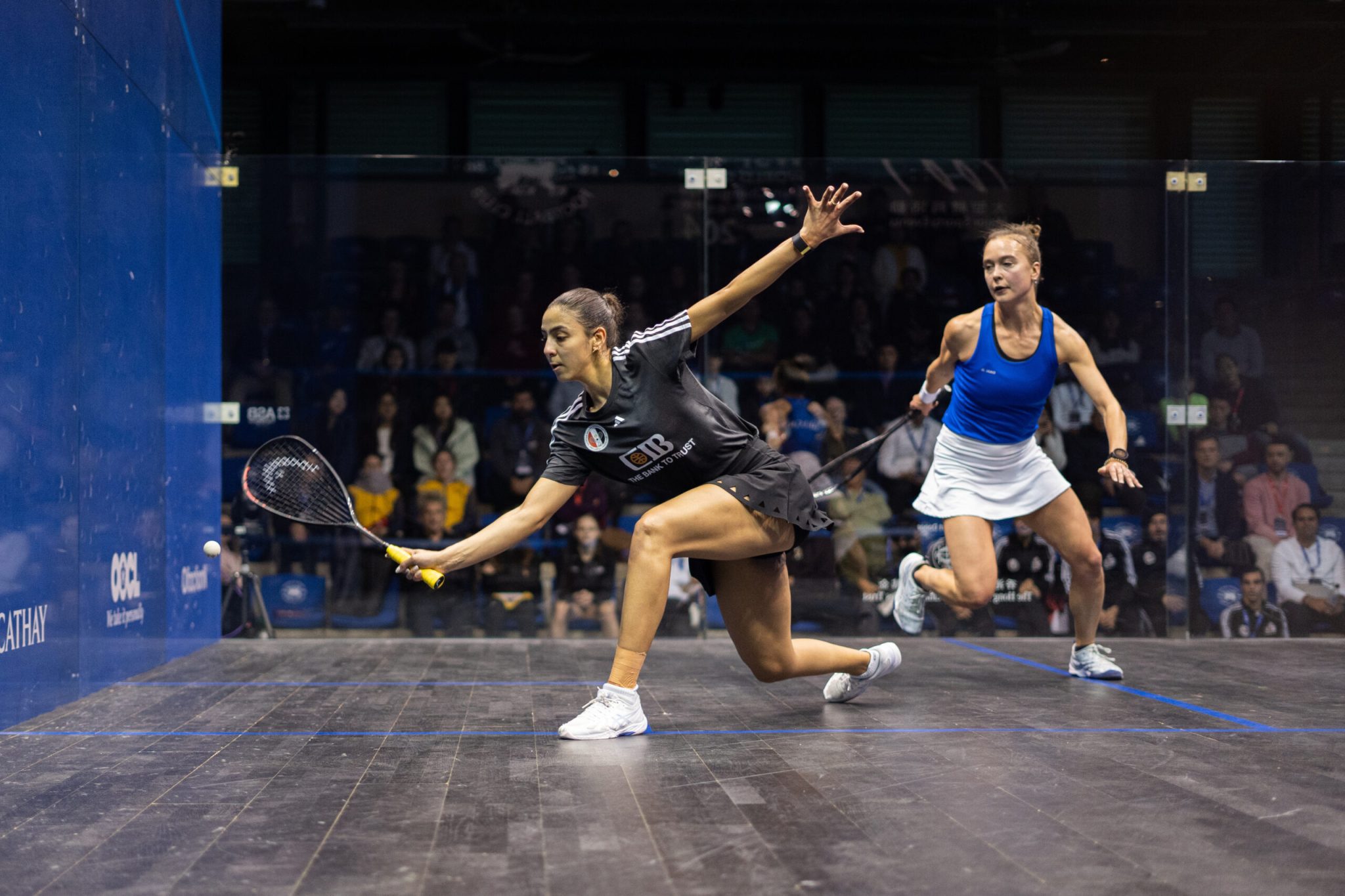
A player lunges almost into a split to retrieve it.
Another ball screams deep into the back corner.
Both athletes somehow occupy the same court without crashing into each other.
Ten shots become twenty.
Twenty become thirty.
Neither player can escape.
There is no net separating them.
There is nowhere to hide.
And unlike tennis, the walls aren’t boundaries.
The walls are part of the game.
This is squash.
Fast.
Physical.
Tactical.
Claustrophobic.
Explosive.
And for more than a century, completely absent from the Olympic Games.
That changes in Los Angeles.
At LA28, squash will finally make its Olympic debut, with men’s and women’s singles competition and just 32 athletes — 16 men and 16 women — competing for the first Olympic squash medals in history.
For a sport that has spent decades trying to reach the Olympic stage, this is much more than another tournament.
It could be the biggest discovery opportunity squash has ever had.
Did You Know?
Squash has never previously been an Olympic medal sport.
The International Olympic Committee approved squash for Los Angeles 2028 alongside flag football, cricket, lacrosse and baseball/softball.
Flag football and squash will make their Olympic debuts, while the other three sports are returning to the Games.
Squash’s first Olympic champions will therefore become permanent pieces of sports history.
By the Numbers
| Squash Market Indicator | Snapshot |
|---|---|
| International governing body | World Squash Federation |
| Professional governing body/tour | Professional Squash Association |
| Players | 2 in singles |
| Primary playing area | Enclosed four-wall court |
| Game scoring | First to 11 points |
| Standard match | Best of 5 games |
| Olympic debut | Los Angeles 2028 |
| Olympic athletes at LA28 | 32 |
| Olympic field | 16 men / 16 women |
| Olympic events | Men’s Singles / Women’s Singles |
| LA28 venue | Universal Studios Lot |
| U.S. governing body | US Squash |
| Major professional circuit | PSA Squash Tour |
| Major championship | World Squash Championships |
LA28’s current competition schedule places squash at the Comcast Squash Center at Universal Studios in Universal City, with the women’s medal matches scheduled for July 23, 2028, and men’s medal matches for July 24. The schedule remains subject to change.
Watch Squash in Action
Squash is much easier to appreciate once you stop expecting it to look like tennis.
Watch the movement first.
Notice how players repeatedly return toward the middle of the court after hitting.
Watch how they use the corners.
Listen to the ball.
Notice the changes of pace.
A player may hammer one shot and barely touch the next.
Then watch the physical battle.
Because both players occupy the same space, they must constantly navigate around one another while maintaining access to the ball.
That gives squash a dimension almost no other major racket sport has.
Start here:
Professional Squash Association
The home of elite professional squash, including tournaments, rankings, players, results, video and the PSA Squash Tour.
World Squash Federation
The international governing body and primary resource for the global sport, national federations, championships, development and rules.
Olympic Squash
Follow squash’s journey toward its historic Olympic debut at Los Angeles 2028.
US Squash
An excellent resource for learning the game, finding development pathways and understanding the rapidly evolving American squash ecosystem.
What Is Squash?
Squash is a racket sport played inside an enclosed four-wall court.
Two players take turns striking a small rubber ball against the front wall.
The ball can rebound off the side and back walls, but it must reach the front wall legally before bouncing twice on the floor.
The objective is straightforward:
Make your opponent unable to return the ball before its second bounce.
Simple.
Until you actually try it.
Unlike tennis or badminton, squash players share the same playing space.
That means every shot changes not only where the ball goes, but where both athletes must move next.
The player who hits the ball generally tries to recover toward the central area of the court known as the T.
Control the T and you can reach more of the court efficiently.
Lose control of it and your opponent begins making you run.
And run.
And run.
That is where squash becomes fascinating.
A rally is simultaneously a contest over the ball and territory.
Understanding the Squash Court
The squash court itself is one of the sport’s defining characteristics.
There are four walls:
- Front wall
- Back wall
- Left side wall
- Right side wall
And unlike many sports, almost all of them can become part of a shot.
The front wall contains several important markings.
The Tin
At the bottom of the front wall sits the tin.
Hit the ball into or below it and the shot is down.
The tin essentially acts like the net in tennis.
Except it is vertical.
The Out Line
A ball hitting above the upper boundary is out.
Service Line
The service line helps determine whether a serve is legal.
Service Boxes
Players begin service from designated boxes on the floor.
The T
The intersection of court markings near the center forms the strategic heart of squash.
Players constantly attempt to recover here after hitting.
Why?
Because the T provides efficient access to all four corners.
At elite level, squash often becomes a battle over who controls those few square feet of floor.
How Squash Scoring Works
Modern professional squash generally uses point-a-rally scoring.
A game is played to 11 points.
If the score reaches 10–10, a player must win by two points.
Matches are generally played as the best of five games.
That creates a scoring system that new fans can understand quickly.
But the rallies themselves can become remarkably sophisticated.
The Shots That Define Squash
Squash contains an entire vocabulary of shots.
Drive
A straight shot played close along a side wall.
It sounds basic.
It isn’t.
A great drive forces an opponent deep into the back corner while allowing the striker to regain control of the T.
Crosscourt
The ball travels diagonally from one side of the court toward the other.
Crosscourts can change the geometry of a rally instantly.
Drop Shot
One of squash’s most beautiful weapons.
Instead of hitting with power, the player gently sends the ball toward the front wall so that it dies near the front of the court.
After forcing an opponent deep, a perfectly executed drop can be devastating.
Boast
A boast deliberately uses a side wall before the ball reaches the front wall.
Suddenly the walls themselves become attacking angles.
Lob
A high, softer shot designed to travel over an opponent and die deep in the court.
Volley
Players can strike the ball before it bounces.
Taking the ball early reduces an opponent’s recovery time and can completely change the pace of a rally.
Kill
A low attacking shot designed to end the rally.
The best squash players combine all of these.
Power.
Softness.
Height.
Angles.
Deception.
And timing.
That is what turns squash from simply hitting a ball against a wall into a strategic racket sport.
Why People Love Playing Squash
Squash gives players something increasingly rare:
a tremendous amount of sport in a very small space.
You do not need a huge field.
You do not need ten teammates.
You do not need good weather.
Two people.
Two rackets.
One ball.
One court.
And almost immediately, you are competing.
The sport also produces an unusual sense of intensity.
There are few pauses.
The opponent is always nearby.
The ball is constantly returning.
Every poor shot creates another problem almost immediately.
And because players can manipulate the walls, rallies contain enormous variety.
Power alone will not save you.
Speed alone will not save you.
Fitness alone will not save you.
You need all of them — plus touch, anticipation and decision-making.
How Athletes Become Great Squash Players
Elite squash players may be among the most complete athletes in racket sports.
Movement
Squash movement is highly specialized.
Players repeatedly:
- Accelerate
- Decelerate
- Lunge
- Recover
- Change direction
- Rotate
- Reach
- Sprint
And they must do it while sharing the court with an opponent.
Efficient movement can save enormous amounts of energy over a long match.
Racket Skills
Players develop:
- Forehand drives
- Backhand drives
- Drops
- Volleys
- Boasts
- Crosscourts
- Lobs
- Defensive retrievals
- Attacking kills
At higher levels, deception becomes increasingly important.
The same swing preparation may produce several different shots.
That forces opponents to delay their movement.
A fraction of a second can matter.
Fitness
Squash demands a brutal combination of:
- Aerobic endurance
- Anaerobic capacity
- Repeated sprint ability
- Leg strength
- Core strength
- Mobility
- Balance
French professional Victor Crouin recently described elite squash as a sport where athletes are essentially constantly in action, emphasizing the combination of speed, power, endurance and explosiveness required.
Tactical Intelligence
Great squash is not simply about retrieving one more ball.
Players construct rallies.
They push opponents deep.
Attack the front.
Change direction.
Hold shots.
Vary pace.
Create fatigue.
Then attack the space that opens.
The best players can make an exhausting physical sport look like chess played at sprinting speed.
The Athlete Development Pathway
A typical squash pathway might look like:
Learn to Play → Club or Community Squash → Junior Competition → National Junior Competition → College / Elite Development → PSA Competition → National Team / World Championships → Olympic Qualification
But squash has an advantage over many highly structured sports.
Players do not necessarily need to pursue elite competition.
US Squash emphasizes multiple pathways, including recreational, social, competitive, tournament, scholastic, collegiate and professional participation.
That gives squash genuine lifetime-sport potential.
A player can start young.
Compete seriously.
Play in college.
Move into adult leagues.
And remain involved for decades.
College Squash: A Distinctive American Pathway
The United States has an especially interesting squash ecosystem because of the sport’s relationship with colleges and universities.
College squash is governed by the College Squash Association.
US Squash lists dozens of varsity men’s and women’s programs alongside additional club teams, with squash represented at many prestigious American universities.
That creates an unusual development proposition.
Squash can simultaneously be:
a recreational sport,
a junior tournament sport,
a scholastic team sport,
a college sport,
an international sport,
and now an Olympic sport.
US Squash reported in January 2026 that overall participation had increased 130% over the long-term transformation period it was reviewing, while scholastic participation increased 450%. Its National High School Championship has grown from 16 teams in 2004 to approximately 200 teams from more than 20 states.
That American foundation becomes much more interesting with LA28 approaching.
From Prison Walls to Glass Show Courts
Squash’s history is one of the most unusual among major racket sports.
Its ancestors developed from racket games played against walls.
The modern game evolved in England during the nineteenth century, particularly at schools where players experimented with softer balls that could be squashed against walls.
That softer ball changed everything.
Instead of simply rebounding predictably, it created a game requiring movement, anticipation and tactical use of the entire enclosed court.
Over time, squash spread through clubs, schools, universities and international sporting communities.
Then the court itself evolved.
Traditional squash courts hid much of the action behind walls.
Modern professional glass courts transformed the spectator experience.
Suddenly a court could be constructed inside:
arenas,
public spaces,
shopping environments,
historic buildings,
and spectacular temporary venues.
The glass court turned squash into something portable.
And that could become enormously important at the Olympics.
The Olympic Breakthrough
Squash spent decades trying to get here.
Now it finally has its moment.
In October 2023, the IOC approved squash for the Los Angeles 2028 program.
It will make its Olympic debut alongside flag football, while baseball/softball, cricket and lacrosse return to the Games.
At LA28, the Olympic field will be exceptionally exclusive:
16 men.
16 women.
32 squash athletes total.
Think about what that means.
Millions of people who have never intentionally watched a professional squash match could suddenly encounter it.
And the presentation opportunity is extraordinary.
LA28 has assigned squash to the Universal Studios Lot.
A transparent glass squash court surrounded by Olympic spectators in Los Angeles has the potential to make the sport look completely different to the casual viewer than an old enclosed club court.
That matters.
Sports discovery is visual.
And squash finally has the world’s biggest stage.
Global Growth Analysis
Squash already possesses many ingredients of a global sport.
International federations.
National associations.
Professional competition.
World championships.
Junior development.
College competition.
Continental games.
Major tournaments.
Male and female professional stars.
Its challenge has traditionally been visibility.
Squash can thrive inside clubs while remaining almost invisible to people outside them.
That creates an unusual market situation.
The product already exists.
The players already exist.
The competitions already exist.
The infrastructure already exists in many markets.
What squash needs is a larger discovery funnel.
LA28 can provide one.
Where Is Squash Strong?
Egypt
No discussion of modern squash can begin anywhere else.
Egypt has become one of the defining powers of professional squash.
Egyptian players have dominated major championships and world rankings across the men’s and women’s games.
That success has created a powerful cycle:
Champions create attention.
Attention creates participation.
Participation creates talent.
Talent creates more champions.
Egypt demonstrates what happens when a sport develops a genuine national performance culture.
England
England occupies a foundational place in squash history and remains one of the game’s most important participation and competitive markets.
Its clubs, competitions and development systems helped spread the game internationally.
United States
The United States is especially important now.
US Squash has developed community, junior, scholastic, college and high-performance pathways, headquartered at the Arlen Specter US Squash Center in Philadelphia.
And now the United States will host squash’s Olympic debut.
That creates a once-in-a-generation domestic growth opportunity.
France
France has produced elite international players and maintains a strong competitive squash infrastructure.
The Olympic opportunity is particularly meaningful for current stars who spent much of their careers believing the Games might never arrive.
Asia
Squash has substantial traditions across parts of Asia.
Pakistan produced some of the greatest players in the history of the sport, while Malaysia, Hong Kong, India and other markets have built strong competitive traditions.
Latin America
Squash’s inclusion in major multi-sport competitions has helped develop the game across the Americas.
The Olympic pathway provides another incentive for national sporting systems to invest in elite development.
Women’s Squash: Built Into the Olympic Opportunity
One of squash’s strengths is that the women’s game does not need to be bolted onto the Olympic product later.
It arrives together.
Men’s singles.
Women’s singles.
Sixteen athletes in each field.
The professional sport already features established women’s rankings, tournaments, stars and championships.
That gives squash an opportunity to present itself immediately as a sport with parallel elite men’s and women’s products.
For brands, broadcasters, federations and event organizers, that matters.
Olympic visibility can amplify both simultaneously.
The Business of Squash
Squash has a fascinating commercial ecosystem because it sits at the intersection of participation sport, clubs, facilities, equipment, professional events, education and international competition.
International Governance
World Squash Federation
The WSF governs the international sport and connects national federations, international championships, rules, development and the Olympic movement.
The Olympic breakthrough gives the federation an unprecedented platform for global growth.
Professional Squash
Professional Squash Association
The PSA operates and coordinates the men’s and women’s professional squash circuit.
Professional squash provides rankings, tournaments, championships, athlete storylines and the elite product that will feed directly into Olympic interest.
The PSA describes itself as the players’ association responsible for organizing and coordinating the men’s and women’s professional circuits worldwide.
United States
US Squash
US Squash is the national governing body in the United States and operates across community programs, junior competition, scholastic squash, adult participation, high performance and national teams.
College Squash
College Squash Association
The CSA oversees the American collegiate game and gives squash a valuable connection to higher education and university athletics.
Equipment and Manufacturers
Squash does not require an enormous equipment package.
That helps accessibility once a court is available.
A player primarily needs:
- Squash racket
- Squash balls
- Court shoes
- Protective eyewear where required or recommended
- Athletic clothing
- Grip
- Equipment bag
But within those categories exists a specialized performance market.
Dunlop Sports
One of the most recognizable brands in squash, with rackets, balls and accessories deeply associated with the sport.
HEAD
A major international racket-sports company producing squash rackets, footwear and equipment.
Tecnifibre
A prominent racket-sports brand with significant involvement in professional squash.
Karakal
A specialist racket-sports brand with a long presence in squash equipment.
Prince
A historic racket brand associated with squash as well as other racket sports.
Squash balls themselves create an interesting product distinction.
Different balls have different bounce characteristics.
And unlike a basketball or soccer ball, a squash ball behaves differently depending partly on its temperature.
As rallies continue, the ball warms up.
It becomes more lively.
The game literally changes as it is played.
The Squash Court Economy
The biggest economic barrier to squash is not the racket.
It is the court.
A regulation squash court is specialized infrastructure.
That creates business opportunities around:
- Court construction
- Glass walls
- Flooring
- Lighting
- Clubs
- Universities
- Recreation centers
- Private facilities
- Coaching
- Leagues
- Events
- Court booking
- Facility technology
Historically, the enclosed court also created a spectator problem.
Modern glass show courts have helped solve it.
Professional tournaments can now construct spectacular temporary courts in locations designed to attract attention.
That gives squash something unusual:
its playing environment can become part of the event.
LA28’s Universal Studios setting could demonstrate that to an enormous audience.
Media, Data and Technology
Technology could play an important role in making Olympic squash understandable to first-time viewers.
The ball moves quickly.
Angles can be difficult to perceive.
Players constantly cross one another’s paths.
Broadcast tools can help explain:
- Ball speed
- Rally length
- Player movement
- Court positioning
- Shot placement
- Distance covered
- Heart-rate intensity
- T control
- Winners and errors
Glass courts also allow cameras to capture the game from multiple perspectives.
Overhead views can reveal tactical patterns.
Low angles can emphasize speed.
Slow motion can show the extraordinary mechanics of movement and racket control.
The sport’s Olympic breakthrough is therefore not merely about putting squash on television.
It is an opportunity to rethink how squash is presented.
Major Squash Competitions
Los Angeles 2028 Olympic Games
This will be the historic one.
For the first time, Olympic medals will be awarded in squash.
The current LA28 schedule places the competition at the Universal Studios Lot, culminating with women’s medal matches on July 23 and men’s medal matches on July 24, 2028.
World Squash Championships
The World Championships represent the pinnacle of the established international/professional game.
Long before Olympic medals existed, becoming world champion represented squash’s ultimate achievement.
LA28 adds another prize.
It does not replace that history.
PSA Squash Tour
The professional tour creates the year-round competitive ecosystem from which stars, rankings and rivalries emerge.
World Team Championships
National-team competition provides another dimension to a sport most commonly associated with individual play.
College Squash Championships
The American collegiate system creates team competition within a traditionally individual sport.
That makes college squash particularly interesting from a sports-development perspective.
Why LA28 Could Change Squash
The most important thing about the Olympics may not be what happens during those matches.
It may be what happens afterward.
Imagine a viewer watching squash for the first time.
They see a glass court.
They see two athletes sprinting.
They hear the ball exploding off the front wall.
They see a 40-shot rally.
They watch a player dive toward the front corner.
They learn that this is the first Olympic squash tournament ever.
Then they search:
“Where can I play squash near me?”
That search is the opportunity.
Olympic inclusion can increase:
- Awareness
- Participation
- Junior interest
- Facility demand
- Sponsorship
- Broadcast value
- Equipment sales
- Federation investment
- National-team funding
- Athlete visibility
But none of those outcomes happen automatically.
The squash industry needs to convert Olympic curiosity into participation.
That means the real race begins after people discover the sport.
The Future of Squash
Squash has already won the battle it fought for decades.
It got into the Olympics.
Now comes a harder challenge:
What does the sport do with the opportunity?
Several forces will shape the answer.
Olympic Visibility
LA28 provides a global audience that squash could never create independently.
American Growth
US Squash enters the Olympic cycle with established junior, scholastic, collegiate and community infrastructure. Participation and scholastic growth over the organization’s long-term development period provide a meaningful foundation.
Glass Courts
Portable show courts allow squash to escape traditional club environments and become a spectator event.
Digital Highlights
Squash produces excellent short-form sports content:
Impossible retrievals.
Long rallies.
Deceptive drops.
Dives.
Explosive winners.
Those moments can introduce the game quickly.
Community Access
This may be the biggest issue.
Olympic exposure means little if interested people cannot find a court.
Growing access beyond traditional private-club environments could determine how much of the Olympic opportunity becomes sustainable participation.
Global Sports Market Index
| Market Factor | Score | Global Sports Market View |
|---|---|---|
| Participation Potential | 9/10 | Simple player requirements and lifetime participation potential |
| Global Reach | 9/10 | Established across multiple continents with strong international competition |
| Accessibility | 7/10 | Equipment is manageable, but specialized courts limit access |
| Spectator Appeal | 9/10 | Fast rallies, physical intensity and glass courts create a compelling product |
| Professional Ecosystem | 9/10 | Established men’s and women’s professional tour |
| Youth Development | 9/10 | Strong junior pathways in numerous markets |
| Women’s Growth Opportunity | 9/10 | Established elite women’s game enters Olympics alongside men’s competition |
| Commercial Potential | 9/10 | Equipment, facilities, clubs, coaching, events and Olympic exposure create multiple opportunities |
| Olympic Opportunity | 10/10 | Historic debut at LA28 provides unprecedented discovery potential |
| Discovery Value | 10/10 | Familiar enough to understand, unusual enough to surprise |
| Overall | 91/100 | Olympic Breakthrough Market |
Global Sports Market Intelligence Rating
91 / 100
Classification: Olympic Breakthrough Market
Squash already possesses most of the infrastructure of a mature international sport.
Professional players.
World championships.
National federations.
Junior systems.
College programs.
Equipment brands.
Specialized facilities.
International competition.
What it has never possessed is an Olympic platform.
Until now.
That single change could alter the sport’s commercial trajectory.
Final Thoughts
Squash has spent much of its history behind walls.
Literally.
People could be playing an extraordinary match inside a club while someone walking ten feet away had no idea it was happening.
That has always been part of squash’s charm.
And part of its problem.
The game is spectacular once you see it.
But millions of people have never seen it.
Los Angeles 2028 changes the equation.
For the first time, squash will not be asking the world to come find the sport.
The sport is going to the world.
Thirty-two athletes will step onto the Olympic court knowing they are doing something no squash player has ever done before.
Someone will win the first women’s Olympic squash gold medal.
Someone will win the first men’s.
And millions of people may discover that hitting a little rubber ball against four walls can produce one of the fastest, smartest and most physically demanding competitions in sport.
Squash spent decades trying to get into the Olympics.
Now the interesting question is what happens because it finally did.
Global Sports Market Verdict
Market Position: Established international racket sport entering a transformational Olympic cycle
Accessibility: Equipment is relatively accessible, but court availability remains the primary barrier
International Reach: Strong across Europe, North America, Africa, Asia and other international markets
Commercial Ecosystem: Established across professional competition, equipment, clubs, facilities, coaching and events
Women’s Market: Mature elite competition with equal Olympic-event visibility
Olympic Value: Potentially transformational
Growth Opportunity: Exceptional if LA28 awareness converts into participation and facility access
Discovery Value: Exceptional
Editorial Verdict
Squash may be one of the best examples of why Olympic inclusion matters.
This isn’t an invented sport searching for legitimacy.
It isn’t a niche competition created yesterday.
Squash already has generations of history, world champions, professional stars, national federations, college programs and passionate communities around the globe.
What it has lacked is the world’s biggest sports megaphone.
In 2028, it gets one.
And the Olympic presentation could hardly be better.
A transparent court.
Elite athletes.
Thirty-two competitors.
Universal Studios.
Los Angeles.
The first medals in the sport’s history.
For a sport that has spent so much time enclosed by four walls, LA28 could finally blow the doors open.
Global Sports Market Intelligence Rating: 91/100
Explore the Sport
World Squash Federation
The international governing body for squash and the primary gateway into the sport’s worldwide federation, championship, rules and development ecosystem.
Professional Squash Association
Follow the world’s leading professional players, rankings, tournaments, results and major championships on the PSA Squash Tour.
Los Angeles 2028
Follow squash’s historic journey toward its first Olympic Games. LA28 currently plans to stage squash at the Universal Studios Lot.
Olympics
Explore the Olympic movement’s coverage of squash as the sport prepares to award its first medals in 2028. The LA28 field is planned for 16 men and 16 women.
US Squash
The national governing body for squash in the United States, with resources covering community participation, juniors, schools, adult squash, elite development and Team USA.
College Squash Association
Explore the distinctive American collegiate squash ecosystem, including varsity and club competition.
US Squash — Start Playing
A useful resource for understanding how players can enter the sport through recreational, competitive, scholastic and development pathways.
Continue Your Global Sports Discovery Journey
Squash sits inside one of the most fascinating areas of the global sports market: the rapidly evolving world of racket and court sports.
From traditional global giants to newer participation booms, court sports demonstrate how equipment, facilities, social participation and professional competition can create very different sports economies.
Continue exploring related sports across theGLOBALSPORTSMARKET.com, including Pickleball, Teqball, and the wider collection of Court Sports Intelligence Reports.
As additional verified live internal articles from our locked build list are published, they can be connected directly into this discovery pathway rather than inventing URLs that do not yet exist.
Continue Your Global Sports Discovery
The Olympic Games have always been one of the world’s greatest sports-discovery engines.
Every four years, millions of people encounter athletes, games and competitions they may never have deliberately searched for.
At Los Angeles 2028, squash gets its turn.
But squash is only one of hundreds of sports with extraordinary athletes, communities, businesses and stories waiting to be discovered.
Explore more Global Sports Market Intelligence Reports at theGLOBALSPORTSMARKET.com.
Discover the sports. Understand the markets. Explore the opportunities.
Published By
theGLOBALSPORTSMARKET.com
A KODA8, LLC Property
Powered by theGLOBALMARKET.ai
Helping sports fans discover, understand and appreciate the incredible world of sports.

Author: theHowie
We are building a network of digital resources designed to bring some much-needed order to the internet's most chaotic corners. I don't just collect domains; I build them into authoritative hubs for the topics I’m passionate about.