


Bowling is one of those rare sports that almost everyone recognizes, millions of people have played, and yet relatively few appreciate at its highest competitive level.
Walk into a bowling center on a Friday night and you may see birthday parties, families, teenagers, league bowlers, and friends rolling a few games over pizza.
Watch an elite tournament and it looks like an entirely different sport!
Professional bowlers manipulate ball speed, rotation, launch angle, equipment, and lane conditions with remarkable precision. They study oil patterns, adjust their footwork by inches, change bowling balls as conditions evolve, and routinely make decisions that recreational players never realize are part of the game.
That contrast may be bowling’s greatest strength.
It can be entertainment on Saturday night.
It can be a high school varsity sport.
It can become a college scholarship opportunity.
It can become an international competition career.
And for the very best athletes, it can become a profession.
Bowling may not always receive the attention given to football, basketball, soccer, or baseball, but few sports combine accessibility, longevity, competition, technology, recreation, and global participation quite like it.
Quick Facts
Sport: Bowling
Primary Competitive Discipline: Tenpin Bowling
Other Forms: Ninepin bowling, candlepin bowling, duckpin bowling and additional regional variations
International Governing Body: International Bowling Federation
Major U.S. Governing Organization: United States Bowling Congress
Major Men’s Professional Tour: Professional Bowlers Association
Major Women’s Professional Tour: Professional Women’s Bowling Association
College Competition: NCAA National Collegiate Women’s Bowling plus additional collegiate programs and associations
Basic Objective: Knock down ten pins using a bowling ball while accumulating the highest possible score
Perfect Game: 300
Typical Game: 10 frames
Market Stage: Established
Participation Profile: Recreational through elite international competition
Core Strength: Extremely low barrier to initial participation combined with enormous competitive depth
The International Bowling Federation governs bowling internationally and promotes tenpin, ninepin and para bowling while organizing major international competition. The federation is recognized within the Olympic movement and continues to pursue Olympic status for bowling.
The Game Almost Everyone Already Knows
Bowling does not require much explanation at its most basic level.
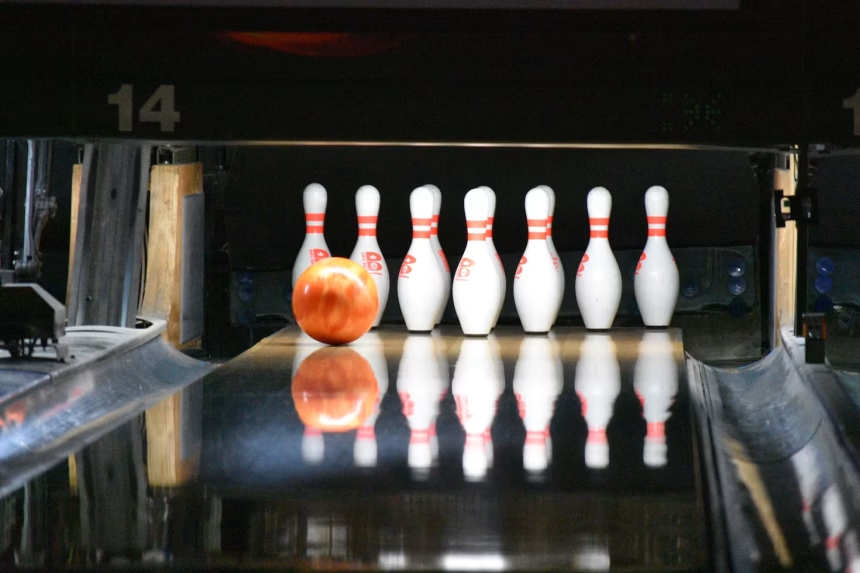
Ten pins stand at the end of a lane.
The bowler rolls a ball toward them.
Knock down all ten on the first delivery and you have a strike.
Leave pins standing and you receive another opportunity.
Ten frames later, the highest score wins.
Simple.
Except competitive bowling becomes dramatically more complicated the deeper you go.
Elite bowlers are not simply aiming at the center pin.
They are creating a precise ball path.
The location of their feet matters. Their release point matters. Revolutions matter. Ball speed matters. Axis rotation matters. The surface and internal construction of the ball matter.
And perhaps most importantly, the lane itself changes while athletes compete.
Oil is applied to bowling lanes in patterns that influence friction. As balls repeatedly travel through those patterns, oil moves and breaks down. A shot that worked twenty minutes earlier may suddenly stop working.
The athlete has to recognize it.
And adjust.
That is where bowling changes from a recreational activity into a sophisticated competitive sport.
Watch Bowling In Action
If you have only experienced bowling during a family outing or casual league night, watching elite competition is worth the time.
Start with the Professional Bowlers Association, which operates the premier professional men’s bowling circuit and provides tournament information, player profiles, rankings, highlights and viewing information.
The PBA traces its history to 1958 and today has thousands of members competing internationally through the PBA Tour, PBA50 Tour and regional competition.
Women’s professional bowling is represented at the highest level by the Professional Women’s Bowling Association. The PWBA dates to 1960 and was relaunched in its modern form in 2015 with support from the United States Bowling Congress and Bowling Proprietors’ Association of America.
International competition can be followed through the International Bowling Federation, which organizes world-level championships and international events.
Watching elite players quickly changes the perception that competitive bowling is merely “throwing a ball at pins.”
By The Numbers
A standard tenpin bowling game consists of 10 frames.
A strike knocks down all ten pins with the first ball of a frame.
A spare knocks down all ten pins using both deliveries.
A perfect game is 300.
The mathematics of scoring reward consecutive strikes because the pins from subsequent deliveries are added as bonuses.
That means bowling produces enormous pressure late in games.
An athlete who begins a game with eleven consecutive strikes enters the final delivery needing one more strike for perfection.
Everyone in the building knows it.
The bowler knows it.
The audience knows it.
And ten pins suddenly look very small.
At the professional level, success is built around far more than score alone. Tournament bowlers may compete across numerous qualifying games, changing lane pairs and adapting constantly before reaching match-play or televised championship rounds.
The PBA’s competitive structure includes national, regional and senior-level competition, while the PWBA provides a professional pathway for women.
The Athlete Experience
Bowling looks effortless when performed properly.
That is deceptive.
Competitive bowlers repeat an athletic movement hundreds of times while trying to reproduce nearly identical mechanics.
Balance is critical.
So are timing, lower-body stability, shoulder control, hand position, wrist strength, flexibility and coordination.
A competitive bowling ball can weigh up to 16 pounds, meaning tournament athletes repeatedly accelerate significant weight while maintaining extremely precise mechanics.
Then there is the mental component.
One bad shot does not end a game.
One bad game may not end a tournament.
Athletes have to process information continuously without allowing frustration to destroy their execution.
The best bowlers appear calm because they have learned to manage an enormous number of variables at once.
Bowling Is A Sport Of Adjustments
One of the most fascinating parts of high-level bowling is something casual players rarely encounter:
lane transition.
Bowling lanes are conditioned with oil.
Tournament organizers can vary the length, volume and distribution of oil across the lane, creating different competitive environments.
The bowling ball reacts differently depending on how much friction it encounters.
As competition continues, the pattern changes.
Experienced bowlers watch other competitors’ shots.
They watch where balls begin hooking.
They notice when pins stop carrying the same way.
Then they move.
Sometimes the adjustment is a different target.
Sometimes it is different speed.
Sometimes it is a completely different bowling ball.
This creates one of bowling’s most intriguing competitive characteristics:
The playing surface is changing while the competition is happening.
Equipment Is Part Of The Strategy
Bowling may be one of the most equipment-sensitive sports in the world.
Competitive bowling balls are engineered products.
Different balls contain different core designs, coverstocks and surface characteristics. Those variables influence how early the ball begins reacting to the lane and how aggressively it changes direction.
That is why elite bowlers often arrive at tournaments with multiple bowling balls.
They are not backups.
They are strategic tools.
The Professional Bowlers Association maintains equipment registration requirements for professional competition. Current registered ball manufacturers include major bowling brands such as Brunswick, Hammer, MOTIV, Roto Grip, Storm and others.
Other important equipment includes:
- Bowling shoes
- Wrist supports
- Finger inserts
- Bowling bags
- Grip products
- Ball-cleaning equipment
- Towels and shammy pads
- Protective tape
- Ball resurfacing equipment
This equipment ecosystem creates a legitimate sporting-goods market surrounding competitive bowling.
Youth Bowling: Where The Sport Can Build Its Future
Bowling has an advantage many youth sports would love to have.
The basic game is easy to start.
A child does not need years of technical training before participating.
Bowling centers already have the infrastructure.
Rental equipment is readily available.
Competition can be organized by age and ability.
That accessibility gives bowling an excellent development platform.
In the United States, the United States Bowling Congress oversees major parts of the sport’s competitive infrastructure.
USBC Youth programs support certified leagues, coaching, skill development and tournaments, including events such as Junior Gold and USA Bowling competition.
Young bowlers can therefore move through a recognizable development pathway:
Recreational bowling → youth leagues → tournaments → high school competition → collegiate bowling → elite amateur or professional competition.
That is exactly the kind of progression that helps sports retain participants.
High School Bowling Deserves More Attention
Bowling fits high school athletics exceptionally well.
Teams can compete without enormous stadium investments.
Boys and girls can participate.
Athletes who may not fit the traditional football-basketball-baseball pipeline can discover a competitive sport in which technique and decision-making are enormously important.
Bowling also provides something increasingly valuable in youth sports:
A realistic lifetime connection to the game.
Most high school football players will never play organized football again.
Most high school bowlers can continue bowling for decades.
That matters.
A strong scholastic system does more than produce elite bowlers.
It creates lifelong customers, league participants, coaches, tournament competitors and fans.
College Bowling Creates A Serious Competitive Pathway
Bowling also exists at the collegiate level.
The NCAA conducts a National Collegiate Women’s Bowling Championship, making bowling part of the formal NCAA championship system.
The 2026 championship field included 19 teams, with programs qualifying through both conferences and at-large selections. Jacksonville State won the 2026 national championship, defeating Wichita State in the final.
That provides something particularly important for young bowlers and their families:
A destination.
College sports pathways make youth participation more meaningful. Athletes can envision representing a university, competing nationally, receiving institutional support and potentially advancing beyond college.
Bowling has that ladder.
It just does not receive nearly as much public attention as many larger NCAA sports.
Women’s Bowling Has A Real Professional Platform
Women’s bowling deserves separate attention because the sport has one of the more established professional structures available to women outside the largest mainstream sports.
The Professional Women’s Bowling Association operates national and regional competition and attracts elite athletes from around the world.
The PWBA originally formed in 1960 and was relaunched in 2015 after an extended absence from the professional landscape.
That professional presence complements collegiate women’s bowling particularly well.
A young athlete can see an identifiable progression from junior bowling to college competition and ultimately to professional tournaments.
Those pathways matter enormously when developing a sport.
The Professional Bowlers Association
At the top of men’s professional bowling sits the Professional Bowlers Association.
Founded in 1958, the PBA has become bowling’s most recognizable professional organization.
Its competition ecosystem includes:
- PBA Tour
- Major championships
- PBA Regional Tour
- PBA50 Tour
- Junior competition
- International participation
The organization reports thousands of members representing countries around the world.
Professional bowling also remains a television and streaming product.
For the 2026 season, PBA coverage includes broadcasts and streaming across platforms including The CW, CBS, Paramount+, CBS Sports Network and BowlTV.
That media footprint matters because bowling is unusually suited to television.
The audience understands the objective immediately.
One athlete performs at a time.
The pins provide instant visual feedback.
And pressure increases visibly as matches approach their conclusion.
Fan Appeal
Bowling is one of the easiest sports in the world to understand as a spectator.
You do not have to explain complicated scoring zones or obscure tactical rules.
Ten pins.
Knock them down.
That simplicity creates immediate tension.
But experienced bowling fans see another layer.
They watch ball motion.
They recognize oil-pattern adjustments.
They understand why a player changes equipment.
They know when a delivery was missed before the ball reaches the pins.
That combination—simple enough for a newcomer but complex enough for an expert—is one of the characteristics shared by many great spectator sports.
Global Footprint
Bowling is not simply an American pastime.
The International Bowling Federation represents the sport internationally and governs tenpin bowling, ninepin bowling, para bowling and related disciplines.
Its mission includes international development, world championships and the continued pursuit of Olympic and Paralympic inclusion.
Competitive bowling has significant communities throughout parts of:
North America, Europe, Asia, Latin America, the Middle East and Oceania.
Countries including the United States, South Korea, Malaysia, Singapore, Japan, Sweden, Finland and others have produced internationally competitive bowlers.
The professional tours themselves increasingly reflect this globalization.
The PBA includes international members, and the PWBA regularly features competitors from outside the United States.
Bowling And The Olympic Question
Bowling has one particularly interesting gap in its international résumé.
It is not currently an Olympic medal sport.
Tenpin bowling appeared as a demonstration sport at the 1988 Seoul Olympic Games, but it has never become part of the permanent Olympic medal program.
The International Bowling Federation remains recognized within the Olympic movement and explicitly identifies achieving Olympic status as part of its mission.
Bowling also appeared on The World Games program for decades, beginning with the inaugural World Games in 1981 and continuing through the 2022 edition.
The Olympic debate is fascinating.
Bowling has global participation.
It has men’s and women’s competition.
It has a simple spectator proposition.
It requires relatively compact venues.
It has existing international governance.
And it produces television-friendly competition.
Its challenge is not proving that bowling is competitive.
Its challenge is positioning itself inside an increasingly crowded international sports landscape.
Where Bowling Is Growing
Bowling’s growth opportunity may not look like the explosive expansion of a newly invented sport.
Its opportunity is different.
Bowling already has infrastructure.
It already has awareness.
It already has generations of participants.
The opportunity is to modernize how people perceive and experience it.
That means strengthening:
Youth competition.
High school programs.
College pathways.
Professional storytelling.
International tournaments.
Digital coverage.
Short-form video.
Modern bowling centers.
Entertainment-based participation.
And easier connections between recreational players and organized competition.
The distance between “we went bowling tonight” and “I joined a league” may be smaller than the equivalent transition in almost any other sport.
That is an enormous advantage.
The Business Of Bowling
Bowling occupies an unusual position because the recreational and competitive businesses overlap.
A bowling center can simultaneously serve:
Families.
Birthday parties.
Corporate events.
Casual bowlers.
Youth leagues.
High school teams.
Adult leagues.
Tournament players.
Professional events.
That creates numerous revenue channels.
The surrounding bowling economy includes:
Bowling-center operations, equipment sales, ball drilling and pro shops, footwear, apparel, coaching, tournament entry fees, sponsorship, media rights, food and beverage, entertainment, leagues, camps and travel competition.
The PBA’s current registered-equipment ecosystem demonstrates the number of manufacturers competing within the serious bowling market.
Bowling centers themselves are also changing.
Many modern facilities combine bowling with arcade gaming, restaurants, bars, interactive technology and other entertainment attractions.
That can introduce people to bowling recreationally.
The industry’s challenge is converting some of those visitors into repeat participants.
Equipment & Facilities
Unlike many sports, the facility is the largest barrier to independent participation.
You cannot build a regulation bowling lane in the backyard.
But once a bowling center exists, the sport becomes highly accessible.
The facility provides:
Lanes.
Pins.
Automatic scoring.
Ball returns.
Rental shoes.
Rental bowling balls.
Seating.
Food and beverage.
Competition space.
That dramatically reduces the amount of personal equipment required for a beginner.
Serious players eventually purchase their own balls and shoes, but someone can experience the sport for the first time with virtually no equipment investment.
That is powerful.
Explore Bowling
For players, parents, coaches, fans and anyone interested in learning more about the sport, these organizations provide strong starting points.
International Bowling Federation
International Bowling Federation
The international governing body for bowling, including world-level competition and development.
United States Bowling Congress
United States Bowling Congress
The primary national governing organization for organized bowling in the United States.
Professional Bowlers Association
Professional Bowlers Association
Follow professional men’s bowling, players, rankings, schedules and tournaments.
Professional Women’s Bowling Association
Professional Women’s Bowling Association
The premier professional women’s bowling tour.
NCAA Bowling
NCAA Bowling
Follow collegiate women’s bowling, rankings, postseason competition and the NCAA championship.
The Global Sports Market Index
Accessibility: 9/10
One of bowling’s strongest advantages. Beginners can participate immediately using equipment supplied by the facility.
Global Reach: 8/10
Organized internationally with meaningful competitive communities across multiple continents.
Youth Opportunity: 8/10
Youth leagues, tournaments, high school competition and collegiate pathways provide a strong developmental structure.
Professional Opportunity: 7/10
Established men’s and women’s professional tours exist, although earning a sustainable living remains difficult for athletes below the highest competitive levels.
Fan Appeal: 7/10
Simple scoring and dramatic pressure make bowling surprisingly television-friendly.
Equipment Market: 8/10
Bowling balls, footwear, accessories, apparel and specialist pro-shop services create a substantial sport-specific equipment ecosystem.
Facility Accessibility: 7/10
Bowling centers make participation extremely convenient where they exist, although the sport depends heavily on specialized facilities.
Growth Potential: 8/10
Bowling’s combination of existing infrastructure, entertainment participation and competitive pathways gives the sport significant modernization potential.
Global Sports Market Intelligence Rating
8.0 / 10
Bowling scores unusually well because it already possesses many of the pieces emerging sports spend decades trying to create.
It has facilities.
It has participants.
It has recognizable rules.
It has equipment manufacturers.
It has youth competition.
It has high school participation.
It has college competition.
It has men’s and women’s professional tours.
It has international governance.
And almost everyone already knows what bowling is.
Its greatest problem is perception.
Bowling’s recreational accessibility sometimes hides its competitive sophistication.
That is also its opportunity.
The sport does not necessarily need people to discover bowling.
It needs them to rediscover what bowling can be.
Did You Know?
A perfect game is 300, but achieving one requires 12 consecutive strikes, not ten. The first nine frames require one strike each, while the tenth frame allows two additional deliveries after a strike.
Bowling was showcased as a demonstration sport during the 1988 Seoul Olympics.
The Professional Bowlers Association was founded in 1958.
The Professional Women’s Bowling Association traces its origins to 1960.
Bowling appeared on The World Games program beginning in 1981 and remained part of the program through 2022.
Competitive bowlers frequently carry several different bowling balls because lane conditions and oil patterns can require different equipment during the same tournament.
Final Verdict
Bowling might be one of the most misunderstood established sports in the world.
Because millions of people encounter it casually, it is easy to underestimate what happens when the game becomes competitive.
But follow the sport from youth leagues through high school, college, international championships, the PWBA and the PBA and a different picture emerges.
This is a technical sport.
A mental sport.
An equipment sport.
A lifetime sport.
And perhaps most importantly, an incredibly accessible sport.
A child can throw their first bowling ball without owning a single piece of equipment.
That same child can eventually compete for a school, a university, a national team or a professional championship.
There aren’t many sports capable of offering that entire journey.
Bowling has been hiding in plain sight for decades.
Maybe it is time we started looking at it differently.
Continue Your Global Sports Discovery Journey
If bowling’s combination of accessibility, technique and global competition interests you, keep exploring the world of sports through theGLOBALSPORTSMARKET.com:
Beyond the Basement: Why Table Tennis Is One of the World’s Biggest Sports
Why Pickleball Matters: The Sport That Nobody Saw Coming
Why Floorball Matters: The Fast-Paced Global Sport Most Fans Have Never Discovered
Competitive Cheerleading Explained: The Athletic Sport Built on Strength, Precision and Teamwork
Cross Country Explained: More Than Just Running Through the Woods
The Global Sports Market exists to help athletes, parents, coaches and fans discover the extraordinary world of sports beyond the games they already know.
Explore more sports. Find organizations. Discover opportunities. And keep expanding your sporting world at theGLOBALSPORTSMARKET.com.
Published by KODA8, LLC / theGLOBALSPORTSMARKET.com

Author: Howie
We are building a network of digital resources designed to bring some much-needed order to the internet's most chaotic corners. I don't just collect domains; I build them into authoritative hubs for the topics I’m passionate about.