




Few sports make extraordinary athletic ability look as effortless as artistic gymnastics.
- Quick Facts: Artistic Gymnastics
- Men’s Artistic Gymnastics
- Women’s Artistic Gymnastics
- Olympics — Artistic Gymnastics
- International Gymnastics Federation
- USA Gymnastics
- Floor Exercise
- Pommel Horse
- Still Rings
- Vault
- Parallel Bars
- Horizontal Bar
- Uneven Bars
- Balance Beam
- Strength
- Flexibility
- Explosive Power
- Balance
- Spatial Awareness
- Mental Control
- Youth Participation
- Women’s Sports Momentum
- Athlete-Led Audiences
- Digital Media
- Emerging National Programs
- International Governance
- Olympic Ecosystem
- United States
- Collegiate Gymnastics
- Olympic Games
- FIG Artistic Gymnastics World Championships
- FIG World Cup Circuit
- National Championships
- NCAA Gymnastics
- 9.1 / 10 — Global Power Sport
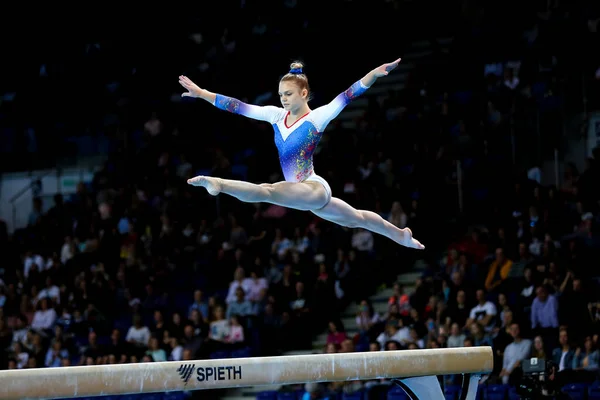
A gymnast can sprint toward a vault at full speed, launch into the air, twist multiple times and land within inches of where intended. Another athlete can hold nearly his entire body weight motionless above a pair of rings. On the balance beam, gymnasts perform flips, leaps and combinations on a surface only 10 centimeters wide.
Then there is the horizontal bar, where athletes intentionally release their grip while flying high above the ground—and somehow find the bar again.
That combination of strength, flexibility, explosive power, balance, spatial awareness, courage and precision gives artistic gymnastics an identity unlike almost anything else in global sport.
It is also a sport whose mainstream visibility changes dramatically with the calendar. Millions of people who rarely watch gymnastics during an ordinary year become completely absorbed when the Olympic Games arrive.
Stars such as Simone Biles, Rebeca Andrade and Sunisa Lee can suddenly become international sports figures far beyond the traditional gymnastics audience. Biles and Andrade finished first and second in the women’s all-around at Paris 2024, while Lee took bronze.
That Olympic spotlight matters.
But artistic gymnastics is much bigger than two weeks every four years.
Behind those performances is an international ecosystem of gymnastics clubs, coaches, equipment manufacturers, national federations, collegiate programs, World Championships, World Cups and youth development systems.
For the Global Sports Market, that makes artistic gymnastics especially interesting:
It is a globally recognized Olympic sport supported by an enormous developmental and commercial infrastructure that most casual fans rarely see.
Quick Facts: Artistic Gymnastics
| Sport | Artistic Gymnastics |
| Category | Gymnastics |
| Category URL | /gymnastics/artistic-gymnastics |
| Global Governing Body | International Gymnastics Federation (FIG) |
| United States Governing Body | USA Gymnastics |
| Olympic Sport | Yes |
| Olympic Debut | 1896 |
| Men’s Apparatus | Floor Exercise, Pommel Horse, Still Rings, Vault, Parallel Bars, Horizontal Bar |
| Women’s Apparatus | Vault, Uneven Bars, Balance Beam, Floor Exercise |
| Competition Formats | Team, Individual All-Around, Individual Apparatus |
| Market Stage | Established Global Olympic Sport |
| Global Sports Market Intelligence Rating | 9.1 / 10 |
| Primary Strength | Olympic recognition + youth participation + global federation infrastructure |
| Major Opportunity | Converting Olympic audiences into year-round followers |
What Is Artistic Gymnastics?
Artistic gymnastics is the best-known competitive discipline within the larger gymnastics family.
Athletes perform routines on specialized apparatus, with judges evaluating combinations of difficulty and execution.
The objective is not simply to complete spectacular skills.
Gymnasts must connect those skills into technically demanding routines while demonstrating control, form, amplitude and precision.
Men and women compete on different combinations of apparatus.
Men’s Artistic Gymnastics
Men compete on six:
- Floor Exercise
- Pommel Horse
- Still Rings
- Vault
- Parallel Bars
- Horizontal Bar
Women’s Artistic Gymnastics
Women compete on four:
- Vault
- Uneven Bars
- Balance Beam
- Floor Exercise
At major international competitions, athletes can compete for medals as part of a team, in the individual all-around, and on individual apparatus.
That creates multiple stories within a single sport.
An athlete can become one of the world’s best all-around gymnasts, capable of competing across every apparatus, while another can reach international competition through extraordinary specialization on a particular event.
Did You Know?
Artistic gymnastics has been part of the Olympic movement since the first modern Olympic Games in Athens in 1896.
The sport has changed enormously since then.
Modern gymnastics incorporates increasingly difficult combinations, sophisticated equipment, advanced sports science and highly specialized coaching.
Some gymnasts become so influential that new skills are eventually associated with their names.
That is part of what has made Simone Biles such an important figure in the evolution of women’s gymnastics. Her combination of power, difficulty and innovation has expanded perceptions of what is possible in the sport.
Yet the fundamental appeal of gymnastics remains remarkably simple:
What can the human body accomplish when strength, technique, courage and movement come together?
That question is at the heart of artistic gymnastics.
By the Numbers
| Metric | Artistic Gymnastics |
| Men’s Apparatus | 6 |
| Women’s Apparatus | 4 |
| First Modern Olympic Appearance | 1896 |
| Global Governing Body | FIG |
| Major International Championship | FIG Artistic Gymnastics World Championships |
| Olympic Competition | Team, All-Around & Apparatus |
| Development Model | Club → Regional/National → Elite → International |
| Global Sports Market Rating | 9.1 / 10 |
The numbers only tell part of the story.
Gymnastics has one of the most recognizable developmental pipelines in sport.
A child can enter a local gymnastics center without any expectation of becoming an Olympian and still participate in a sport connected directly to a worldwide competitive structure.
That grassroots-to-Olympic connection is one of artistic gymnastics’ greatest assets.
Watch Artistic Gymnastics in Action
Artistic gymnastics is a sport that needs to be watched to be fully understood.
Start with the official sources.
Olympics — Artistic Gymnastics
The Olympic platform provides athlete profiles, competition coverage, highlights, results and historical performances from the sport’s biggest global stage.
International Gymnastics Federation
FIG is the international governing body for gymnastics and the primary resource for World Championships, World Cups, rankings, rules, calendars and international competition.
USA Gymnastics
For American athletes, families and fans, USA Gymnastics provides competition information, national-team coverage, athlete development resources and pathways into the sport.
FIG’s international competition structure continues well beyond the Olympics, including an Artistic Gymnastics Apparatus World Cup circuit featuring men’s and women’s events.
That distinction matters.
The Olympics may introduce someone to gymnastics.
The international competitive system gives them a reason to keep following it.
The Apparatus: Ten Different Tests of Athletic Ability
One reason artistic gymnastics remains so compelling is that its apparatus demand very different abilities.
Floor Exercise
Floor combines tumbling, power, landing control and choreography.
Athletes generate remarkable speed and rotational force while remaining within the competition area and controlling their landings.
Women’s floor routines also combine high-level tumbling with dance and musical interpretation.
At Paris 2024, Rebeca Andrade became one of the defining athletes of the Games and further elevated Brazil’s position within international gymnastics.
A great floor routine demonstrates why artistic gymnastics is more than raw athleticism.
Power has to become performance.
Pommel Horse
The pommel horse is one of gymnastics’ great technical challenges.
Athletes maintain continuous movement while supporting themselves primarily through their arms and shoulders, swinging their legs around and across the apparatus.
There are few opportunities to recover from a significant mistake.
Rhythm matters enormously.
For casual viewers, pommel horse can initially look almost mechanical.
Watch closely and it becomes something else entirely: an exercise in momentum, body position, endurance and extraordinary control.
Still Rings
Rings provide perhaps the clearest demonstration of pure upper-body strength in artistic gymnastics.
Athletes combine swinging elements with strength positions and transitions before finishing with a dismount.
The remarkable part is not simply holding difficult positions.
It is making them appear controlled.
The apparatus magnifies every unnecessary movement. The rings themselves tell the viewer whether an athlete is truly in control.
Vault
Vault is gymnastics compressed into seconds.
The athlete accelerates down the runway, attacks the springboard, makes contact with the vault table and converts horizontal speed into vertical flight and rotation.
There is very little time to correct anything.
A tiny error during takeoff can become a major error during landing.
It is also an apparatus where Simone Biles has helped redefine the limits of women’s gymnastics.
Her influence demonstrates something important about star athletes in individual sports:
A single athlete can change not only who watches a sport, but what future athletes believe is possible within it.
Parallel Bars
Parallel bars require athletes to move above, below and between two rails.
Swinging elements, releases, strength movements and dismounts combine into routines demanding excellent timing and body control.
At elite level, the transition between skills can look effortless.
It isn’t.
Horizontal Bar
The horizontal bar can produce some of the most spectacular moments in men’s gymnastics.
Athletes build enormous momentum through giant swings before performing releases, catches, rotations and high-difficulty dismounts.
For spectators, the appeal is immediate.
At some point you realize the athlete has intentionally released the bar several meters above the ground—and now has to find it again.
Uneven Bars
Women’s uneven bars turn two rails at different heights into a continuous sequence of swings, transitions, releases and pirouettes.
Elite routines can look almost impossibly fluid.
That fluidity hides the precision required to hit handstands, generate momentum and reconnect with the apparatus after release skills.
Sunisa Lee has become one of the sport’s most recognizable modern athletes, combining international elite competition with the visibility created by American collegiate gymnastics.
Lee won the Olympic all-around title at Tokyo 2020 and later returned to the Olympic all-around podium. Olympic records confirm her Tokyo gold ahead of Rebeca Andrade.
Balance Beam
The beam may be the ultimate psychological test in gymnastics.
Athletes perform turns, leaps, flips and acrobatic combinations on an apparatus only about 10 centimeters wide.
Skills that would be impressive on a full floor become extraordinary when performed on such a narrow surface.
Beam exposes hesitation immediately.
Confidence becomes part of the performance.
Why People Love Artistic Gymnastics
Gymnastics has something sports organizations spend enormous amounts of money trying to manufacture:
instant visual comprehension.
A first-time spectator doesn’t need to understand the Code of Points to recognize that a gymnast flying above the horizontal bar is doing something extraordinary.
You don’t need years of gymnastics experience to understand the tension of balance beam.
You don’t need to understand every deduction to appreciate a stuck vault landing.
That accessibility gives gymnastics tremendous broadcast value.
At the same time, experienced fans can go much deeper—analyzing difficulty, connections, execution, technique and routine construction.
That combination allows gymnastics to serve both audiences.
The Athlete Experience
Artistic gymnastics develops an unusual collection of athletic qualities.
Strength
Gymnasts develop exceptional strength relative to body weight.
Rings provide the obvious example, but strength is fundamental across virtually every apparatus.
Flexibility
Athletes need functional flexibility that allows them to move through extreme positions while maintaining control.
Explosive Power
Vault and tumbling demand enormous force production in extremely short periods.
Balance
Balance isn’t limited to the beam.
Gymnastics constantly requires athletes to understand where their bodies are in relation to the apparatus and ground.
Spatial Awareness
Gymnasts rotate across multiple axes while airborne.
Knowing where the floor, beam, bar or landing mat is—often without being able to see it continuously—is fundamental.
Mental Control
Fear cannot simply be removed from gymnastics.
Athletes learn to manage it.
That may be one of the sport’s most transferable lessons.
How Gymnasts Become Great
Nobody begins gymnastics by learning Olympic-level skills.
The sport is built on progression.
Young gymnasts first develop fundamental movement patterns:
running, jumping, landing, rolling, swinging, balancing and supporting their body weight.
Those fundamentals become the foundation for more advanced skills.
As athletes progress, training becomes increasingly specialized.
Coaches break complicated skills into manageable components. Athletes practice those components using mats, pits, spotting systems and progressions before attempting complete skills independently.
At higher levels, success increasingly depends on details:
- body position
- amplitude
- landing control
- hand placement
- timing
- flexibility
- strength
- routine composition
- consistency
The spectacular skills get the television highlights.
The thousands of repetitions behind them create the gymnast.
The Stars Who Expand the Sport
Every global sport benefits from athletes who become bigger than the competition itself.
Artistic gymnastics has produced many.
Simone Biles has become one of the most recognizable athletes of her generation and helped bring gymnastics into conversations extending well beyond sport.
Rebeca Andrade has become a landmark figure for Brazilian and Latin American gymnastics. Research hosted by the Olympic World Library has even examined increased interest in gymnastics classes at her Flamengo club following her success at Tokyo.
Sunisa Lee became Olympic all-around champion at Tokyo and remained among the sport’s elite athletes during the next Olympic cycle.
On the men’s side, Japan’s Kohei Uchimura became one of the defining all-around gymnasts of the modern era, while generations of champions from Japan, China, Europe, the United States and elsewhere have helped build men’s artistic gymnastics into a truly international competition.
These athletes matter to the Global Sports Market for a reason that goes beyond medals.
They provide an entry point.
Someone may not search for “artistic gymnastics international competition structure.”
They may search for Simone Biles.
Then they discover the sport.
That connection between athlete → sport → competition → organization → participation is one of the most powerful discovery pathways in the modern sports economy.
Youth & Development
This may be one of the most important parts of the artistic gymnastics market.
Gymnastics doesn’t require a child to begin with dreams of Olympic competition.
Many families enter simply because they want children to move.
That creates a broad entry point.
Recreational gymnastics can help develop coordination, balance, strength, flexibility and confidence. Athletes who enjoy the sport can then move into structured competitive programs.
In the United States, USA Gymnastics oversees the national structure and athlete-development pathways.
Other countries operate through their own national federations under the international FIG structure.
This creates an enormous network of local organizations beneath the elite international sport.
And that matters commercially.
Every gymnastics club represents more than athletes.
It can involve:
- coaches
- judges
- administrators
- equipment
- apparel
- camps
- competitions
- facility rentals
- travel
- family spending
The Olympic sport is the visible tip.
The development system underneath it is the market.
The Global Footprint
Artistic gymnastics has one of the strongest international footprints among individual Olympic sports.
The United States has become one of the most visible women’s programs, while countries including Brazil, China, Japan, Great Britain, Italy and nations throughout Europe and Asia regularly contribute elite athletes.
Men’s artistic gymnastics has its own competitive geography, with Japan and China carrying enormous historical and contemporary importance.
The sport’s medal tables have also demonstrated its geographic diversity across generations. Olympic results have featured champions and medalists from the United States, Japan, China, Brazil, Great Britain, Greece, Switzerland, Germany, Russia and numerous other countries.
What makes the sport especially interesting is that global success isn’t permanently controlled by one country.
Programs rise.
Athletes emerge from unexpected places.
Investment in coaching and development can change a country’s competitive position.
And one extraordinary athlete can create an entirely new generation of gymnastics fans.
Where Artistic Gymnastics Is Growing
The next stage of gymnastics growth isn’t necessarily about inventing a new version of the sport.
It is about expanding access to the existing one.
Youth Participation
Gymnastics remains an attractive foundational activity for young children because parents don’t need to understand elite competition for the sport to make sense.
Movement itself is the product.
Women’s Sports Momentum
Women’s artistic gymnastics already occupies a valuable position within the expanding global women’s sports landscape.
It has recognizable athletes, Olympic history and an established broadcast product.
Athlete-Led Audiences
Modern sports fans increasingly follow athletes directly.
That gives gymnastics an important advantage.
A star gymnast’s audience can follow them across the Olympics, World Championships, collegiate competition, sponsorships and social media—creating a relationship with the sport that no longer depends entirely on traditional television schedules.
Digital Media
Gymnastics is exceptionally suited to short-form video.
A spectacular vault, tumbling pass or release move can be understood in seconds.
That creates enormous discovery potential.
Emerging National Programs
International development continues to broaden the number of countries capable of producing competitive gymnasts.
The more geographically diverse the elite field becomes, the larger the potential global audience becomes.
The Business of Artistic Gymnastics
Artistic gymnastics isn’t a professional-league business like soccer, basketball or American football.
Its ecosystem is different.
And that difference is important.
International Governance
International Gymnastics Federation (FIG)
FIG governs international gymnastics competition and oversees rules, World Championships, World Cups, international calendars and global development.
Its competition structure connects national federations to world-level gymnastics.
Olympic Ecosystem
Olympics — Artistic Gymnastics
The Olympic Games remain artistic gymnastics’ most powerful global media platform.
For many casual fans, the Olympics are their primary point of contact with gymnastics.
That creates both an enormous advantage and a challenge:
Gymnastics already receives extraordinary global exposure. The opportunity is converting more of those Olympic viewers into year-round followers.
United States
USA Gymnastics
USA Gymnastics oversees the sport nationally in the United States, including athlete pathways, national competitions and elite teams.
The American club system also creates a substantial grassroots gymnastics economy.
Collegiate Gymnastics
NCAA Women’s Gymnastics
College gymnastics provides an important bridge between elite development and spectator sport in the United States.
Women’s NCAA gymnastics in particular gives athletes another high-profile competitive environment beyond the traditional international pathway.
Equipment & Facilities: An Industry Hidden Inside the Sport
Gymnastics requires specialized infrastructure.
A serious artistic gymnastics facility may contain:
- sprung floor systems
- vault tables
- runways
- uneven bars
- parallel bars
- horizontal bars
- rings
- balance beams
- pommel horses
- landing mats
- training pits
- spotting equipment
- springboards
- strength and conditioning areas
That creates a specialized global equipment and facility market.
SPIETH Gymnastics
A major international gymnastics equipment manufacturer supplying apparatus and training equipment.
GYMNOVA
A prominent gymnastics equipment company serving training and competition environments.
AAI — American Athletic
A longstanding American gymnastics equipment manufacturer serving clubs, schools and competitive programs.
Janssen-Fritsen
An international sports equipment supplier with a significant history in gymnastics apparatus.
This is an important distinction when evaluating the sport commercially.
A soccer program can begin with a field, goals and balls.
A serious gymnastics operation requires significant facility and equipment investment.
That creates a higher barrier to entry—but it also supports a substantial specialized business ecosystem.
Major Artistic Gymnastics Competitions
Olympic Games
The pinnacle of mainstream global visibility.
Olympic gymnastics creates athletes who can become internationally recognizable beyond the traditional gymnastics audience.
FIG Artistic Gymnastics World Championships
The World Championships are among the sport’s most important international competitions, producing team, all-around and apparatus champions.
FIG World Cup Circuit
FIG’s World Cup structure gives elite athletes opportunities to compete internationally outside the Olympics and World Championships, creating a broader year-round competition ecosystem. Recent FIG World Cup events continue to feature men’s and women’s apparatus competition.
National Championships
National federations operate domestic championships that help determine national rankings, teams and international assignments.
NCAA Gymnastics
American collegiate gymnastics provides a distinctive team-focused spectator experience and another valuable pathway for athletes.
Fan Appeal
Artistic gymnastics possesses almost every ingredient required for compelling sports entertainment.
Risk.
Every routine carries the possibility of failure.
Difficulty.
Fans know immediately that the athletes are attempting things most humans couldn’t come close to doing.
Precision.
Small differences matter.
Personality.
Individual athletes remain visible throughout the competition.
National identity.
International competitions create natural country-versus-country storylines.
Drama.
One mistake can change an entire team competition.
And perhaps most importantly:
the sport creates moments.
A perfect landing.
An unexpected fall.
A breakthrough performance.
A gymnast standing motionless after completing a routine they have trained years to perform.
Those moments translate exceptionally well to television, social media and digital sports platforms.
The Global Sports Market Index
| Market Factor | Score | GSM View |
| Global Reach | 9.5/10 | Strong federation and Olympic footprint across the world |
| Participation Accessibility | 7.5/10 | Strong youth entry point but specialized facilities are required |
| Fan Appeal | 9.5/10 | Visually spectacular and understandable to casual audiences |
| Olympic / Major Event Strength | 10/10 | One of the signature Summer Olympic sports |
| Youth Development | 9.5/10 | Extensive club-based development infrastructure |
| Commercial Ecosystem | 8.5/10 | Clubs, equipment, apparel, events, coaching and media |
| Digital / Media Potential | 9.5/10 | Exceptional highlight and athlete-driven social potential |
| Growth Opportunity | 8.5/10 | Opportunity to convert Olympic awareness into year-round engagement |
Global Sports Market Index Score: 9.1 / 10
Global Sports Market Intelligence Rating
9.1 / 10 — Global Power Sport
Artistic gymnastics earns one of our strongest ratings.
Not because it has the largest professional league.
It doesn’t.
Not because it generates the commercial revenue of soccer, American football or basketball.
It doesn’t.
Artistic gymnastics scores highly because of the combination of factors that define a durable global sport:
international participation, Olympic prestige, youth infrastructure, instantly recognizable competition, specialized businesses, star athletes, strong women’s sports positioning and enormous digital-media potential.
Few sports combine all of those advantages.
The biggest weakness is equally clear.
Gymnastics’ mainstream audience remains heavily concentrated around major events—especially the Olympic Games.
That represents the opportunity.
The Future of Artistic Gymnastics
Artistic gymnastics doesn’t need to become something different.
It needs to make the sport that already exists easier to follow.
The Olympic Games prove that millions of people will watch gymnastics.
Stars such as Simone Biles, Rebeca Andrade and Sunisa Lee prove that people will follow the athletes.
Now connect the pieces.
Who are the emerging gymnasts?
Where are the next competitions?
How does the World Cup system work?
Where can a child try gymnastics locally?
Where are the clubs?
Who manufactures the equipment?
What competitions are happening nearby?
How can someone watch?
Where can a fan follow the athletes?
Those questions are exactly where the digital sports market is heading.
Fans increasingly expect sports platforms to connect:
Sport → Athlete → Organization → Competition → Club → Facility → Participation
Gymnastics already has every one of those pieces.
They simply aren’t always easy to discover in one place.
Global Sports Market Verdict
| Market Position | Global Olympic Power Sport |
| Accessibility | Moderate to High |
| International Reach | Exceptional |
| Youth Ecosystem | Exceptional |
| Commercial Ecosystem | Strong |
| Athlete Star Power | Exceptional |
| Media Appeal | Exceptional |
| Growth Opportunity | Strong |
| Discovery Value | Exceptional |
The Verdict
Artistic gymnastics is one of the world’s great demonstrations of human athletic ability.
But viewing it only through the Olympics dramatically understates the sport.
Behind every Olympic routine is an enormous global system of local gymnastics clubs, coaches, national federations, equipment manufacturers, competitions, collegiate programs and young athletes learning their first cartwheel.
And at the top of that system are athletes capable of pulling millions of people into the sport.
That’s important.
Because people don’t always discover sports through organizations.
Sometimes they discover them through people.
A child watches Simone Biles.
A Brazilian fan follows Rebeca Andrade.
A college sports fan discovers Sunisa Lee.
Then they begin discovering gymnastics.
That is what makes artistic gymnastics particularly compelling from a Global Sports Market perspective.
The athletes create the connection.
The Olympics create the audience.
The global gymnastics ecosystem creates the market.
Together, they make artistic gymnastics one of the strongest sports discovery opportunities in the world.
Explore Artistic Gymnastics
International Gymnastics Federation
The international governing body and primary source for global gymnastics competitions, rules, rankings and development.
Olympic Artistic Gymnastics
Follow Olympic gymnastics, athlete profiles, historical performances and competition coverage.
USA Gymnastics
The national governing body for gymnastics in the United States and an important resource for athletes, parents, coaches, clubs and fans.
NCAA Women’s Gymnastics
Follow American collegiate gymnastics, including rankings, championships and team competition.
SPIETH Gymnastics
Explore professional gymnastics apparatus and training equipment.
GYMNOVA
Explore another major international manufacturer serving the gymnastics competition and training market.
Continue Your Global Sports Discovery Journey
Artistic gymnastics sits at the intersection of Olympic competition, precision, artistry and extraordinary athletic ability. Continue exploring that world across theGLOBALSPORTSMARKET.com:
What Is Acrobatic Gymnastics?
Explore another gymnastics discipline where partnership, balance, strength and dynamic movement replace the individual apparatus format.
What Is Parkour?
See how running, vaulting, climbing and obstacle movement developed into a competitive discipline now connected to the international gymnastics ecosystem.
What Is Figure Skating?
Explore another Olympic sport where elite athletic difficulty, precision, artistry and performance come together in front of judges.