



Global Sports Market Intelligence Report
Sport: Diving
Primary Category: Water Sports
Market Stage: Established
Global Sports Market Intelligence Rating: 8.8/10
Olympic Status: Summer Olympic Sport
International Governing Body: World Aquatics
- Global Sports Market Intelligence Report
- Did You Know?
- 1-Meter Springboard
- 3-Meter Springboard
- 10-Meter Platform
- Synchronized Diving
- Forward
- Back
- Reverse
- Inward
- Twisting
- Armstand
- Explosive Power
- Body Awareness
- Core Strength
- Flexibility
- Coordination
- Technical Development
- Dryland Training
- Strength and Conditioning
- Mental Development
- China
- United States
- Great Britain
- Canada
- Australia
- Europe
- World Aquatics
- USA Diving
- NCAA
- NFHS
- Olympic Games
- World Aquatics Championships
- World Aquatics Diving World Cup
- NCAA Swimming and Diving Championships
- USA Diving National Competition
- Junior Competition
- Overall Global Sports Market Intelligence Rating
- Editorial Verdict
- World Aquatics Diving
- World Aquatics Diving Competitions
- World Aquatics Diving Rules
- Olympics.com — Diving
- USA Diving
- USA Diving Membership
- NCAA Swimming & Diving
- NFHS Swimming & Diving
- Duraflex International
- Why Figure Skating Matters: The Global Sport Where Athleticism Meets Artistry
- Why Underwater Hockey Matters: The Fast-Paced Underwater Sport Most Fans Have Never Discovered
- Discover Sailing: The Sport Where Wind, Strategy and Innovation Come Together
- Competitive Cheerleading Explained: The Athletic Sport Built on Strength, Precision and Teamwork
The Few Seconds When Everything Has to Be Right
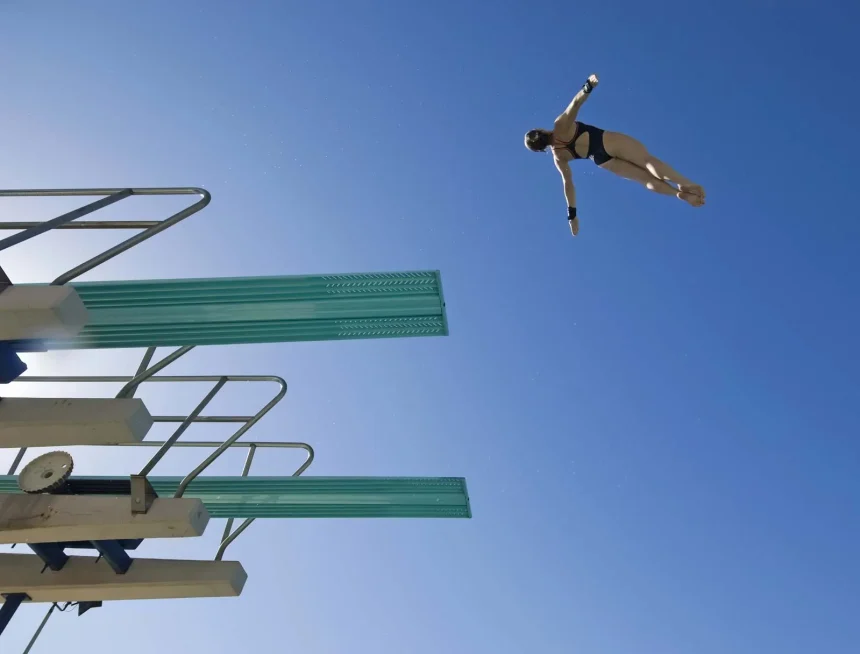
Stand at the edge of a 10-meter diving platform and look down.
The water suddenly seems very far away.
Now imagine jumping from it intentionally.
Not simply jumping, either.
An elite diver may leave the platform, rotate through multiple somersaults and twists, locate the water while still moving through the air, straighten the body and enter a small target area at tremendous speed — ideally creating almost no splash.
The entire performance can be over in less than two seconds.
That is what makes diving so unusual.
There is nowhere to hide.
No teammate can recover the ball.
No defense can make the next stop.
There is no long race in which an athlete can recover from a poor start.
A diver walks to the end of a board or platform, prepares, launches — and commits.
Years of training are compressed into seconds.
It is gymnastics above water, but that description still doesn’t quite capture it.
Because diving adds something else.
Height.
That combination of power, body control, precision and courage has made diving one of the most recognizable events in the Summer Olympic Games.
But the Olympics represent only the top of a much larger ecosystem.
Underneath those spectacular performances are diving clubs, high school teams, NCAA programs, national federations, coaches, aquatic centers, equipment manufacturers, officials, youth programs and families building athletes one skill at a time.
Diving is not simply something spectacular that happens every four years.
It is an established global sport with a highly specialized development system.
Did You Know?
Competitive diving has been part of the Olympic Games for more than a century.
Diving entered the Olympic program at St. Louis 1904. Women’s diving followed at Stockholm 1912, and synchronized diving was added at Sydney 2000.
Today, Olympic diving combines individual and synchronized competition from the springboard and platform.
Diving By the Numbers
| Measure | Global Sports Market View |
|---|---|
| International governing body | World Aquatics |
| Olympic debut | St. Louis 1904 |
| Women’s Olympic debut | Stockholm 1912 |
| Synchronized Olympic debut | Sydney 2000 |
| Primary elite heights | 3m springboard and 10m platform |
| NCAA diving disciplines | 1m, 3m and platform |
| Core skills | Takeoff, elevation, rotation, twisting, body control and entry |
| Major international circuit | World Aquatics Diving World Cup |
| U.S. national governing body | USA Diving |
| High school pathway | NFHS/state associations |
| Key infrastructure | Specialized pools, springboards, platforms and dryland training facilities |
The numbers only begin to explain the sport.
Diving’s real difficulty becomes apparent when you understand how many separate athletic skills must happen correctly during an extremely short period of time.
Watch Diving in Action
Diving is a sport that makes much more sense once you watch elite athletes closely.
Don’t only watch the splash.
Watch the approach.
The hurdle.
The board.
The height generated at takeoff.
How quickly the athlete establishes body position.
The speed of the rotation.
The moment the diver opens from the somersault.
The way the athlete locates the water.
And finally, the entry.
For international competition, athlete profiles, results, video and major events, start with World Aquatics Diving.
The World Aquatics Diving World Cup provides another excellent look at the highest level of international competition.
For the Olympic side of the sport, Olympics.com Diving provides Olympic history, athlete stories, competition information and results.
In the United States, USA Diving provides information about athletes, clubs, competitions and development pathways.
Once you know what to watch, a dive that lasts only a few seconds becomes remarkably complex.
What Is Competitive Diving?
Competitive diving is an aquatic sport in which athletes perform predetermined aerial movements after launching from a springboard or fixed platform.
Judges evaluate the quality of the dive.
At the elite level, athletes must combine technical execution with difficulty.
The major forms of competitive diving include:
1-Meter Springboard
Common in collegiate and other competitive programs, the 1-meter springboard introduces athletes to the timing and mechanics of springboard diving.
3-Meter Springboard
The primary international springboard discipline.
Unlike a fixed platform, the board bends and rebounds.
Divers must learn to work with that movement to generate height before beginning their aerial skills.
10-Meter Platform
The signature high-platform discipline.
The platform is fixed, which changes the takeoff mechanics completely.
At 10 meters, athletes have more time in the air — but also considerably more height and speed to manage.
Synchronized Diving
Two athletes perform dives simultaneously.
That changes the challenge.
Each diver must execute an excellent dive individually while matching the other athlete in timing, height, rotation, body position and entry.
A spectacular individual dive can therefore become an imperfect synchronized dive if the two athletes do not perform it together.
The Six Groups of Dives
Competitive diving organizes dives according to the direction and type of movement.
The major groups include:
Forward
The diver faces forward and rotates forward.
Back
The diver begins facing away from the water and rotates backward.
Reverse
The athlete faces forward but rotates back toward the board or platform.
Inward
The athlete faces backward and rotates toward the board or platform.
Twisting
The dive incorporates twisting movements along with somersaulting actions.
Armstand
Used in platform diving, the athlete begins in a handstand position before leaving the platform.
Within those groups are hundreds of possible combinations.
That is where diving becomes a language.
A knowledgeable diver or coach can look at a dive number and understand the direction, position, number of rotations and other characteristics of the dive.
For the technical side of the sport, World Aquatics Diving Rules provides the official international rules and competition-regulation resources.
Difficulty Changes Everything
Not every dive is worth the same amount.
A relatively simple dive performed beautifully is different from an extremely difficult dive performed beautifully.
Competitive diving therefore incorporates a degree of difficulty.
The more technically demanding the dive, the greater its potential scoring value.
This creates one of diving’s most interesting strategic questions:
How much difficulty can an athlete perform consistently?
Adding difficulty may increase scoring potential.
It also increases risk.
A diver and coach must therefore construct a competitive list that balances ambition with execution.
That is one reason elite diving continues to evolve.
Athletes keep pushing the technical ceiling.
Why the Entry Matters So Much
Casual viewers often judge diving by one thing:
The splash.
There is good reason for that.
A clean entry represents the final result of everything that happened before it.
The athlete must complete the rotation at exactly the right time, establish a straight body line and enter the water vertically.
Elite divers use their hands and arms to help create what is often described as a rip entry — a clean entry producing remarkably little splash.
It looks simple.
It isn’t.
The body is entering the water at considerable speed.
A small error in timing can dramatically change the result.
Why People Love Diving
Diving possesses one of the greatest advantages a sport can have:
You don’t need to understand every rule to appreciate something extraordinary.
A casual spectator may know nothing about degree of difficulty.
They still understand height.
They understand rotation.
They understand synchronization.
They understand a clean entry.
And they definitely understand the courage required to step onto a 10-meter platform.
That makes diving highly discoverable.
It also makes it an exceptional Olympic television sport.
A viewer can arrive with almost no knowledge and quickly become invested in the competition.
The Athlete Experience
Diving athletes develop a remarkably broad collection of physical and mental skills.
Explosive Power
Divers need significant leg power to create height from the board or platform.
More height means more time.
More time creates opportunities for greater technical difficulty.
Body Awareness
Perhaps the defining athletic ability in diving is knowing where the body is while rotating through the air.
Divers must develop extraordinary spatial awareness.
They need to understand their position without the stable visual references available in most sports.
Core Strength
Rotation, twisting, body position and entry all depend heavily on core control.
Flexibility
Divers need mobility and flexibility to create tight shapes in the air while also producing long, clean lines.
Coordination
Every phase of the dive must connect.
Approach.
Takeoff.
Flight.
Rotation.
Opening.
Entry.
A mistake early in the sequence can affect everything that follows.
Diving Is a Mental Sport
The physical demands are obvious.
The psychological demands are easier to miss.
A diver must commit to the skill.
Hesitation can be dangerous.
Athletes therefore build difficult dives progressively through years of repetition.
They learn movement patterns in controlled environments.
They use dryland equipment.
They practice into foam pits.
They work with spotting systems.
They use trampolines.
They develop skills from lower heights before progressing upward.
Eventually, something that once felt impossible becomes familiar enough to perform in competition.
But even then, pressure remains.
The athlete may have only a handful of dives to determine an entire competition.
That requires remarkable emotional control.
How Divers Become Great
Elite divers are not simply fearless children who started jumping from high places.
Development is structured.
Technical Development
Young divers begin by learning fundamentals:
- Body positions
- Entries
- Basic jumps
- Somersault mechanics
- Takeoff technique
- Board control
- Spatial awareness
Only after those fundamentals become reliable do athletes progress toward increasingly difficult skills.
Dryland Training
One of the most important parts of modern diving development may happen outside the pool.
Training facilities can include:
- Trampolines
- Dryboards
- Harness systems
- Foam pits
- Mats
- Strength equipment
- Video analysis
These tools allow athletes to repeat movements without repeatedly absorbing the impact of entering the water.
Strength and Conditioning
Divers develop:
- Leg power
- Core strength
- Shoulder stability
- Mobility
- Flexibility
- Coordination
- Landing and entry control
The physique of an elite diver reflects the sport’s unusual combination of gymnastics-style power and aquatic skill.
Mental Development
Divers also learn how to manage fear.
Not eliminate it.
Manage it.
That distinction matters.
Respect for height and risk is part of the sport.
Elite performance requires athletes to understand that risk while still executing the movement decisively.
From Gymnastics to Diving
The relationship between gymnastics and diving is impossible to ignore.
Both sports depend heavily on:
- Somersaulting
- Twisting
- Spatial awareness
- Flexibility
- Explosive power
- Body positions
- Technical repetition
- Mental commitment
That creates natural crossover.
Some divers have gymnastics backgrounds.
Others discover diving directly through aquatic programs.
The similarities also make diving easy for gymnastics fans to appreciate.
But the sports diverge in one crucial way.
A gymnast must land.
A diver must enter the water.
That changes the entire end of the movement.
From the Local Pool to the Olympic Games
The elite pathway begins far away from the Olympic spotlight.
In the United States, USA Diving serves as the national governing body for the sport and supports clubs, competitions, athlete development and high-performance pathways.
Young athletes can enter through local diving clubs and aquatic programs. USA Diving’s membership system connects athletes to hundreds of member clubs around the country.
From there, competitive opportunities expand.
For some athletes, high school diving becomes an important part of the pathway.
The National Federation of State High School Associations (NFHS) provides swimming and diving rules and educational resources supporting high school competition in the United States.
Then comes college.
And this is where diving has something particularly valuable in the American sports ecosystem.
Diving as a High School Sport
High school diving gives athletes something youth sports sometimes struggle to provide:
A connection between an individual technical sport and a school community.
Divers can represent their high schools while competing within swimming and diving programs.
That matters for visibility.
A student who might never encounter a standalone diving club may discover the sport through a school aquatic program.
High school competition can also provide:
- Structured seasonal competition
- Coaching
- Team identity
- Championship pathways
- Recognition within the school
- A bridge toward collegiate athletics
For theGLOBALSPORTSMARKET.com, this is exactly the type of connection that makes diving strategically interesting.
It exists simultaneously as a local youth sport, high school sport, college sport and Olympic sport.
NCAA Diving Creates a Powerful American Pathway
College diving is one of the sport’s strongest structural advantages in the United States.
The NCAA includes diving within its men’s and women’s swimming and diving championship ecosystem.
At the Division I level, divers compete through a qualification pathway before advancing to the NCAA Championships.
NCAA championship diving includes the familiar collegiate disciplines of:
- 1-meter springboard
- 3-meter springboard
- Platform diving
The college system provides talented athletes with something unusually valuable:
An opportunity to pursue elite athletic development while earning a university education.
It also creates institutional support.
Universities provide coaching, facilities, strength and conditioning, athletic medicine and competitive schedules.
For some divers, the NCAA pathway becomes part of the road toward international competition.
For others, college competition becomes the pinnacle of a long and successful diving career.
Both outcomes matter.
A healthy sport needs meaningful destinations besides the Olympics.
Diving Has Been Olympic for More Than a Century
Diving’s Olympic history stretches back to the early modern Games.
The sport appeared at the 1904 Olympic Games in St. Louis.
Women’s diving joined the Olympic program in 1912.
Over the following decades, diving developed into one of the signature sports of the Summer Games.
Then came another major evolution.
At Sydney 2000, synchronized diving entered the Olympic program.
That addition created an entirely new viewing experience.
Suddenly, spectators weren’t only evaluating the quality of a dive.
They were watching two athletes attempt to make two difficult performances look like one.
The result has become one of the most visually compelling events in Olympic sport.
Fans can explore the sport’s Olympic history, results and athletes through the official Olympics.com Diving resource.
Global Footprint
Diving is international, but competitive strength is not evenly distributed.
Certain countries have developed particularly deep systems.
China
No discussion of modern elite diving can ignore China.
China has built one of the most dominant national programs in international sport, developing generations of technically exceptional divers.
Its athletes have helped redefine expectations for consistency, difficulty and entry quality.
United States
The United States possesses a deep diving tradition supported by clubs, high schools, universities and Olympic history.
The NCAA system gives the country an especially valuable development infrastructure.
Great Britain
British diving has developed significant international visibility through Olympic and World Championship success and a strong national high-performance system.
Canada
Canada maintains a respected international program and continues to play a significant role in international diving.
Australia
Australia’s aquatic culture and high-performance sports infrastructure have helped support a strong international diving presence.
Europe
Countries across Europe maintain established diving programs, clubs and competition structures.
The broader federation system coordinated through World Aquatics connects national programs to international championships and development pathways.
Where Diving Is Growing
The international competition calendar provides a useful window into the sport’s footprint.
The World Aquatics Diving competition system gives athletes from national federations opportunities to compete beyond their domestic programs.
Those events create several forms of growth simultaneously.
Athlete development.
More competitive opportunities.
Federation development.
More countries gain experience developing and supporting elite athletes.
Audience development.
Local fans gain opportunities to see world-class diving.
Facility development.
Competitive diving requires specialized aquatic infrastructure, creating incentives for cities and organizations to maintain high-quality facilities.
This is how global sports ecosystems become deeper.
Not through one giant event.
Through layers of competition underneath it.
The Business of Diving
Diving is not among the world’s largest commercial sports.
But it has a surprisingly sophisticated economic ecosystem.
That ecosystem begins with infrastructure.
World Aquatics
World Aquatics is the international governing body overseeing diving and the broader aquatic sports ecosystem.
It establishes the international competition framework and operates major events, including the World Aquatics Diving World Cup.
USA Diving
USA Diving is the national governing body for competitive diving in the United States.
Its ecosystem includes athletes, clubs, coaches, officials, competitions and development pathways.
Its membership resources provide a useful starting point for athletes, coaches and families entering the sport.
NCAA
The NCAA Swimming & Diving ecosystem provides one of the world’s most important collegiate pathways.
The university system creates coaching jobs, facility demand and competitive opportunities while developing athletes who may continue into international competition.
NFHS
The NFHS Swimming & Diving framework supports the high school level through rules, education and scholastic competition resources.
Together, these organizations demonstrate something important.
Diving isn’t supported by one pathway.
It has interconnected international, national, collegiate, scholastic and club systems.
The Pool Is the Biggest Barrier — and the Biggest Asset
Diving has an infrastructure problem.
You cannot build a legitimate diving program in just any swimming pool.
Competitive facilities require specialized depth, clearances, springboards, platforms and safety specifications.
High-level training may also require:
- Multiple board heights
- Platform towers
- Dryland areas
- Trampolines
- Harnesses
- Dryboards
- Video systems
- Strength and conditioning space
That makes a high-quality diving facility expensive.
But it also makes the right aquatic center extremely valuable.
One facility can support:
- Competitive diving
- Swimming
- Water polo
- Artistic swimming
- Learn-to-swim programs
- Masters programs
- High school teams
- College teams
- Clubs
- Camps
- Meets
- Community recreation
This is why aquatic infrastructure matters far beyond a single sport.
A great pool can become a regional sports hub.
Equipment and Facilities
Compared with many sports, the athlete’s personal equipment needs are relatively simple.
Divers typically need:
- Competition swimwear
- Training swimwear
- Towels or shammy
- Dryland clothing
- Strength and conditioning equipment
- Training accessories
But the facility equipment is highly specialized.
Duraflex International
Duraflex International is one of the best-known names in competitive diving equipment, particularly springboards and diving stands.
Its equipment is closely associated with serious diving facilities and high-level competition.
Aquatic Facility Infrastructure
Modern competition pools require specialized engineering involving depth, water circulation, platforms, deck configuration, lighting and athlete safety.
That means diving’s business ecosystem extends beyond traditional sporting-goods companies into architecture, construction, engineering and aquatic-facility management.
In many sports, the equipment market sits primarily with the athlete.
In diving, much of the investment sits beneath the athlete.
Literally.
Coaching Is Critical
Diving is not a sport where athletes should simply experiment with increasingly difficult movements on their own.
Quality coaching is essential.
A diving coach must understand:
- Technique
- Progression
- Mechanics
- Safety
- Fear management
- Strength development
- Competition strategy
- Degree of difficulty
- Athlete psychology
At higher levels, athlete support may also include:
- Strength coaches
- Athletic trainers
- Sports medicine professionals
- Physical therapists
- Nutrition professionals
- Mental-performance specialists
- Video analysts
For U.S. athletes and families looking for structured programs, USA Diving provides the most logical national starting point.
A great facility can attract athletes.
A great coach can build them.
Media and Digital Potential
Diving is exceptionally well suited to modern media.
A spectacular dive can be understood in seconds.
That makes the sport naturally compatible with:
- YouTube
- TikTok
- Slow-motion replay
- Technical analysis
- Athlete training content
- Olympic highlights
- Behind-the-scenes footage
Slow motion is particularly powerful.
A dive that appears almost impossibly fast in real time becomes understandable when slowed down.
Suddenly viewers can see:
The takeoff.
The tuck.
The twist.
The opening.
The alignment.
The entry.
World Aquatics Diving provides competition video and highlights, while Olympics.com provides another major discovery point for Olympic diving content.
Digital media can therefore do something television historically struggled to accomplish:
Teach people the sport while entertaining them.
That creates enormous discovery potential.
Major Diving Competitions
Olympic Games
The largest global showcase for the sport.
The official Olympics.com Diving hub provides the Olympic gateway into the sport.
World Aquatics Championships
The flagship global aquatic championship brings diving together with the broader family of World Aquatics sports.
Competition information and results are available through World Aquatics Diving.
World Aquatics Diving World Cup
The World Aquatics Diving World Cup is a major international competition series featuring many of the world’s leading divers.
NCAA Swimming and Diving Championships
The NCAA Swimming & Diving Championships represent one of the most important competitive destinations in American collegiate diving.
USA Diving National Competition
USA Diving operates the national competitive structure through which many of America’s leading divers develop and compete.
Junior Competition
World Aquatics and national federations provide junior competition that helps bridge youth development and senior elite diving.
Diving and High Diving Are Not the Same Sport
This distinction is worth making.
Traditional Olympic diving uses springboards and platforms within regulated aquatic facilities.
World Aquatics High Diving pushes the concept considerably higher.
The sports share obvious technical DNA.
But high diving creates different physical, technical and safety demands.
For a new fan, understanding that distinction helps reveal just how broad the world of competitive aquatic sport has become.
Find Diving Near You
Watching Olympic diving often produces a predictable reaction:
Where would someone even learn to do this?
That is the right question.
In the United States, start with USA Diving.
Its national membership and club ecosystem connects athletes with structured programs and qualified coaches.
Families can also investigate:
- Local aquatic centers
- Diving clubs
- YMCA programs
- High school swimming and diving teams
- College aquatic programs
- Municipal pools with diving programs
- University diving camps
The important word is program.
A diving board does not automatically mean a facility provides competitive diving instruction.
Prospective athletes should look for structured coaching and proper facilities.
Internationally, World Aquatics provides the starting point for understanding the global federation and competition structure.
From Global Discovery to Local Participation
Diving demonstrates exactly why sports discovery shouldn’t end with an article.
A person watches an Olympic final.
Then the questions change.
Where is the nearest diving club?
Does my child’s high school have diving?
Which colleges have programs?
Where are the competitions?
Does our local aquatic center have a 3-meter board?
Are there summer diving camps?
Who coaches beginners?
Can a gymnast transition into diving?
Those are discovery questions.
And eventually they become directory questions.
That is where the future sports ecosystem becomes particularly interesting.
Discover → Understand → Care → Find → Participate.
Diving fits that journey perfectly.
What Is the Future of Diving?
Diving already has many of the ingredients needed for long-term stability.
It has:
- Olympic recognition
- More than a century of international history
- Strong national programs
- Youth pathways
- High school competition
- NCAA competition
- Major international events
- Spectacular visual content
- Specialized coaching
- Established facilities
- A recognizable competitive identity
Its biggest constraint is accessibility.
Building soccer fields is relatively straightforward.
Putting a basketball hoop in a gym is straightforward.
Building a legitimate competitive diving facility is not.
That limits where the sport can grow.
But it also makes existing aquatic centers extremely important assets.
The future opportunity lies in connecting more people to those facilities, expanding quality coaching, improving youth pathways and using digital media to turn Olympic fascination into actual participation.
Global Sports Market Index
| Factor | Score | Global Sports Market View |
| Global Recognition | 9.0/10 | Instantly recognizable Olympic sport |
| Olympic Importance | 9.7/10 | One of the Summer Games’ signature aquatic disciplines |
| Participation Potential | 7.5/10 | Strong appeal but constrained by specialized facilities |
| Youth Development | 8.6/10 | Established club, scholastic and national pathways |
| International Reach | 9.0/10 | Organized globally through the World Aquatics federation system |
| Spectator Appeal | 9.3/10 | Short, dramatic and visually understandable |
| Commercial Ecosystem | 7.9/10 | Specialized but meaningful facility, coaching and equipment economy |
| Digital / Media Potential | 9.4/10 | Exceptional highlight and slow-motion potential |
| Accessibility | 6.9/10 | Pool depth, board/platform availability and coaching create barriers |
| Long-Term Growth Opportunity | 8.5/10 | Strong discovery opportunity if local access improves |
Overall Global Sports Market Intelligence Rating
8.8 / 10 — Established Global Olympic Sport
Diving combines exceptional Olympic visibility, a mature international federation structure, established athlete-development systems and tremendous digital appeal.
Its greatest weakness is straightforward:
Not everyone has access to a diving facility.
Its greatest strength is equally clear:
When people see elite diving, they understand immediately that they are watching something extraordinary.
Final Thoughts
There is a reason people stop what they are doing when Olympic diving appears on television.
You don’t need to understand the scoring system.
You don’t need to know the dive number.
You don’t need to know the degree of difficulty.
Someone walks to the end of a 10-meter platform.
You understand.
Then the athlete jumps.
For a few seconds, power, technique, courage and precision come together.
The athlete rotates.
Opens.
Finds the water.
And disappears through the surface.
Almost no splash.
Only after understanding the sport do you begin to appreciate what happened before those few seconds.
The hours in the pool.
The trampoline repetitions.
The dryland work.
The failed dives.
The fear.
The coaching.
The strength training.
The progression from the side of a pool to a 1-meter board, then higher, then harder.
That is what makes diving special.
The performance is incredibly short.
The journey behind it is incredibly long.
Global Sports Market Verdict
Market Position: Established Global Olympic Sport
Accessibility: Moderate to Challenging — specialized aquatic facilities remain the sport’s biggest barrier
International Reach: Excellent
Commercial Ecosystem: Specialized but strong
Olympic Value: Exceptional
High School / College Value: Excellent, particularly within the United States
Digital Discovery Potential: Exceptional
Growth Opportunity: Strong
Discovery Value: 9.3/10
Editorial Verdict
Diving is almost perfectly designed for sports discovery.
It is easy to watch.
Difficult to master.
Visually spectacular.
International.
Olympic.
Accessible to youth in markets with the right facilities.
Connected to high school and collegiate competition.
And supported by a specialized economy of clubs, coaches, aquatic centers, equipment and events.
The sport’s greatest challenge is physical infrastructure.
You cannot build diving everywhere.
But where proper facilities exist, diving can become part of a much larger aquatic sports ecosystem connecting recreational participation, youth development, schools, colleges and elite competition.
And there may be no better demonstration of elite athletic control.
A diver launches into apparent chaos.
Then somehow puts everything back in exactly the right place before reaching the water.
That is diving.
Precision. Power. Courage.
Explore the Sport
World Aquatics Diving
The primary international resource for diving. Follow global competitions, athletes, results, news, videos and the international development of the sport.
World Aquatics Diving Competitions
The international competition hub covering the Diving World Cup, World Aquatics Championships, Olympic results and junior competition.
World Aquatics Diving Rules
The official starting point for international diving rules, competition regulations and technical resources.
Olympics.com — Diving
Explore diving’s Olympic history, athletes, results, videos and major Olympic moments.
USA Diving
The national governing body for diving in the United States and an essential resource for athletes, clubs, coaches, competitions and families.
USA Diving Membership
A practical entry point for athletes, coaches, officials and clubs looking to participate in the U.S. diving ecosystem.
NCAA Swimming & Diving
Follow collegiate swimming and diving championships, results, rankings and the NCAA competition pathway.
NFHS Swimming & Diving
Rules, educational resources and information supporting high school swimming and diving in the United States.
Duraflex International
A major specialist manufacturer associated with competitive diving springboards, stands and aquatic-facility equipment.
Continue Your Global Sports Discovery Journey
Diving sits at the intersection of aquatic skill, aerial athleticism and Olympic competition. Continue exploring sports that share those qualities:
Why Figure Skating Matters: The Global Sport Where Athleticism Meets Artistry
Another precision sport where athletes combine explosive movement, technical difficulty, body control and presentation under enormous competitive pressure.
Why Underwater Hockey Matters: The Fast-Paced Underwater Sport Most Fans Have Never Discovered
Explore a completely different side of the aquatic sports world where breath control, teamwork and underwater movement define the game.
Discover Sailing: The Sport Where Wind, Strategy and Innovation Come Together
Move from the controlled environment of the diving pool to a sport where athletes must master constantly changing natural conditions.
Competitive Cheerleading Explained: The Athletic Sport Built on Strength, Precision and Teamwork
Like diving, competitive cheerleading requires explosive power, aerial awareness, technical progression and the confidence to execute difficult skills under pressure.
Published by KODA8, LLC / theGLOBALSPORTSMARKET.com
Global sports intelligence built to help people discover, understand and connect with the world’s sports.

Author: Howie
We are building a network of digital resources designed to bring some much-needed order to the internet's most chaotic corners. I don't just collect domains; I build them into authoritative hubs for the topics I’m passionate about.