



Global Sports Market Intelligence Report
Sport: Boys’ and Men’s Lacrosse
Category: Team Sports
Market Stage: Established in North America / Expanding Globally
Global Sports Market Intelligence Rating: 8.8/10
Olympic Status: Lacrosse Sixes — Los Angeles 2028
International Governing Body: World Lacrosse
U.S. Governing Body: USA Lacrosse
- Global Sports Market Intelligence Report
- Did You Know?
- Equipment
- Clubs, Camps and Tournaments
- Media and Professional Sport
- Facilities and Community Programs
- Global Sports Market Intelligence Rating: 8.8/10 — High-Growth Global Sports Opportunity
- World Lacrosse
- USA Lacrosse
- USA Lacrosse Boys’ and Men’s Rules
- NCAA Men’s Lacrosse
- Premier Lacrosse League
- National Lacrosse League
- LA28 Lacrosse
- Published By
You Can Hear Lacrosse Before You Understand It
The ball snaps into a stick. Cleats cut across the turf. A defender makes contact. Someone yells “slide.” Two quick passes later, the ball is in the net.
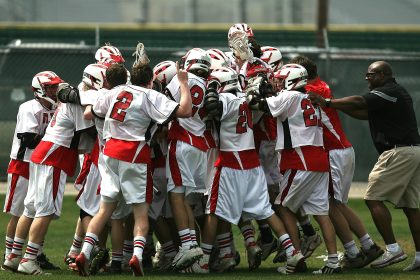
Men’s lacrosse combines speed, contact, stick skill and constant movement. The traditional outdoor game uses 10 players per side. Box lacrosse moves the sport indoors and tightens everything up. Lacrosse Sixes strips it down further into the fast six-a-side version headed to the Olympic Games.
But lacrosse isn’t simply a modern hybrid of hockey, basketball and soccer.
Its Indigenous roots stretch back generations before today’s colleges, professional leagues and equipment companies. The Haudenosaunee relationship with lacrosse remains part of the game’s living identity.
Now one of North America’s oldest sports is entering one of its biggest modern opportunities.
Lacrosse returns to the Olympic Games at Los Angeles 2028 after a 120-year absence.
LA28 will feature six men’s and six women’s national teams playing the Sixes discipline.
For a boy picking up a stick today, the pathway can now lead somewhere earlier generations couldn’t realistically imagine:
the Olympic Games.
Did You Know?
There isn’t really one men’s lacrosse experience.
Field Lacrosse is the traditional outdoor game associated with high schools, colleges and international competition.
Box Lacrosse is played indoors on a hockey-rink-sized surface and is deeply embedded in Canadian lacrosse culture.
Lacrosse Sixes is a smaller, faster version designed for continuous action and international accessibility—and it is the version headed to LA28.
All three begin with the same deceptively difficult skill:
controlling a ball with a stick while everyone around you is moving.
By the Numbers
| Indicator | Boys’ & Men’s Lacrosse |
|---|---|
| Traditional field format | 10 players per team |
| Olympic format | Sixes |
| LA28 men’s field | 6 national teams |
| 2026 NCAA Division I tournament | 18 teams |
| 2026 NCAA champion | Princeton |
| Next Men’s World Championship | Tokyo, 2027 |
| Major professional field league | Premier Lacrosse League |
| Major professional box league | National Lacrosse League |
| International governing body | World Lacrosse |
| U.S. governing body | USA Lacrosse |
The numbers tell an interesting story.
Men’s lacrosse is simultaneously established and unfinished.
In parts of the United States and Canada, generations of families know the sport intimately. Elsewhere, clubs and national programs are still introducing people to it for the first time.
That gap represents much of lacrosse’s future opportunity.
Watch Men’s Lacrosse in Action
The fastest way to understand lacrosse is to watch it.
NCAA Men’s Lacrosse
College lacrosse provides an excellent introduction to the traditional field game, with scores, highlights, statistics, rankings and championship coverage.
Premier Lacrosse League
The PLL showcases many of the world’s best field players. Its 2026 schedule stretches through markets including Baltimore, Charlotte, Long Island, Chicago, Denver, Boston, Philadelphia and others—giving fans opportunities to experience professional field lacrosse in person.
National Lacrosse League
Then watch box lacrosse. The smaller playing surface, boards, physicality and close-range offense produce an entirely different experience.
World Lacrosse
The essential resource for international lacrosse, world championships, national teams, Sixes and Olympic qualification.
What Makes Lacrosse Different?
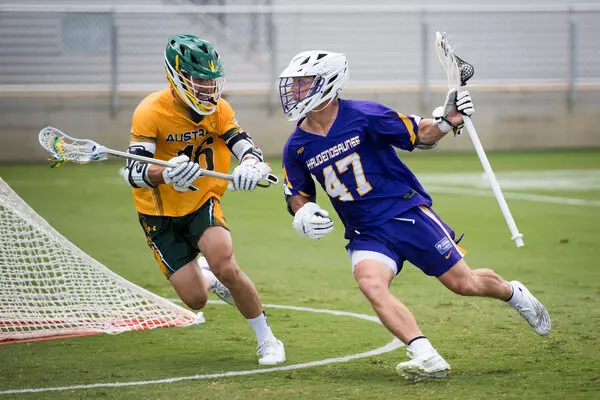
Men’s field lacrosse uses attackmen, midfielders, defensemen and a goalkeeper, with players using either short or long sticks depending on their roles.
But knowing the positions doesn’t really explain the sport.
The stick does.
Players must catch, throw, cradle, dodge, scoop ground balls and shoot while running and absorbing pressure. At higher levels, possession becomes a chess match played at sprinting speed.
Attackers manipulate defenders.
Midfielders create transition.
Long-stick defenders disrupt passing lanes.
Goalkeepers organize the defense.
Faceoff specialists fight for possessions that can change games.
Speed and strength matter, but neither replaces stick skill, vision, creativity or repetition.
That’s why one of lacrosse’s most famous training tools remains remarkably simple:
a ball and a wall.
Why Players Get Hooked
Lacrosse gives young athletes constant little breakthroughs.
The first clean catch.
Catching while running.
Using the weak hand.
Winning a ground ball in traffic.
Beating a defender.
Making the extra pass.
Scoring the first goal.
Improvement is easy to feel, and the game has room for different types of athletes.
Some players win with speed.
Others with strength.
Some see passing lanes before everyone else.
Others become defenders, faceoff specialists or goalkeepers.
Eventually, the game becomes less about carrying a stick and more about seeing possibilities through it.
From a Local Field to the Highest Levels of the Sport
For most families, lacrosse doesn’t begin with college recruiting.
It begins much more simply:
Where can my child play?
A typical American pathway might include:
Recreation Program → Local Club → School Lacrosse → Travel/Club Competition → Camps & Tournaments → College → Professional or National Team
But not every player needs—or wants—the entire ladder.
A healthy lacrosse ecosystem also needs the child who wants to play recreationally, the adult looking for a local league, the parent trying to find a beginner clinic and the fan who simply wants to attend a game.
USA Lacrosse provides rules, coaching, player-development and youth resources for families entering the sport.
Its Boys’ and Men’s Rules resources are particularly useful for understanding how the game changes across youth and scholastic levels.
And that’s where our own mission at theGLOBALSPORTSMARKET.com is evolving.
Knowing what lacrosse is should be only the beginning.
Find the Game, Not Just the Information
Imagine a parent discovers lacrosse through this article.
The useful next question isn’t:
“Can I read another 2,000 words about lacrosse?”
It’s:
“Is anybody playing this near us?”
That’s where the Global Sports Directory becomes important.
As we build it, our goal is to help readers move from discovering lacrosse toward finding real opportunities:
Youth Programs • Clubs • Teams • Leagues • Schools • Box Lacrosse • Facilities • Camps • Tournaments • Showcases • Coaches • College Games • Professional Events
Maybe there’s a beginner program 15 minutes away.
Maybe a college game is happening this weekend.
Maybe a local box league exists that the family didn’t know about.
Maybe an adult who hasn’t touched a stick in 15 years discovers somewhere to play again.
That’s when sports content becomes genuinely useful.
Discovery turns into participation.
College Lacrosse Remains One of the Sport’s Great Engines
American college lacrosse gives the sport something difficult to manufacture:
history.
Programs such as Johns Hopkins, Syracuse, Maryland, Virginia, Princeton, Cornell and Notre Dame connect generations of players and fans.
The 2026 NCAA Division I championship featured an 18-team field.
Princeton eventually defeated Notre Dame 16-9, winning its first national championship since 2001 and seventh overall.
Those championships matter beyond trophies.
College programs create coaches, rivalries, alumni networks, camps, recruiting pipelines, media inventory and thousands of young players who grow up wanting to wear a particular jersey.
For men’s field lacrosse, college remains one of the ecosystem’s strongest foundations.
Professional Lacrosse Now Offers Two Very Different Products
A generation ago, the pathway beyond college could become uncertain.
That has changed.
The Premier Lacrosse League provides a visible professional destination for elite field players, with teams including the Archers, Atlas, Cannons, Chaos, Outlaws, Redwoods, Waterdogs and Whipsnakes.
Then there is the National Lacrosse League.
Box lacrosse compresses the game onto an indoor surface surrounded by boards. Space disappears. Contact increases. Passing and finishing happen in traffic.
Together, field and box give professional lacrosse something unusual:
two genuinely different products built around the same sport.
They also give young players something essential—elite athletes they can watch, study and imagine becoming.
Lacrosse Is Becoming a More Global Sport
The traditional stereotype of men’s lacrosse is narrow: northeastern U.S. schools, Canadian communities and a handful of established hotbeds.
The modern competitive map is broader.
The next World Lacrosse Men’s Championship will be held in Tokyo in 2027, putting one of the sport’s premier international events into a major Asian sports market.
And right now, another important piece of that global story is unfolding.
The inaugural Pan-American Men’s Lacrosse Championship is being held in Kingston, Jamaica in August 2026, with qualification places for the 2027 world championship at stake. The United States roster includes established elite players, while Jamaica, Canada, Haudenosaunee and other national programs are part of the regional competition.
Think about that geographic progression:
Jamaica → Tokyo → Los Angeles.
That doesn’t look much like a sport confined to a handful of traditional American lacrosse communities.
The Indigenous Story Is the Lacrosse Story
Any attempt to explain lacrosse without acknowledging its Indigenous origins misses something fundamental.
Long before NCAA championships, professional franchises or Olympic qualification, Indigenous peoples across North America played stick-and-ball games with deep community and cultural significance.
For the Haudenosaunee, the game remains more than recreation.
And importantly, this isn’t simply history.
Haudenosaunee athletes continue competing internationally today—including in the current Pan-American championship pathway.
Few modern sports can tell a story in which ancient cultural tradition and Olympic-era global expansion remain so visibly connected.
That history deserves to be understood rather than treated as trivia.
The Business of Men’s Lacrosse
Lacrosse’s economic ecosystem begins long before a professional ticket is sold.
Equipment
Traditional men’s field lacrosse requires specialized sticks and protective equipment, supporting established manufacturers such as STX, Warrior, Cascade Maverik and Epoch Lacrosse.
Clubs, Camps and Tournaments
Competitive youth lacrosse generates spending around coaching, registration, tournaments, travel, hotels, uniforms, camps, showcases and private training.
That creates an important local sports economy.
A tournament isn’t only a lacrosse event.
It fills fields.
Hotels.
Restaurants.
Parking lots.
Sporting-goods stores.
Training facilities.
Media and Professional Sport
The PLL and NLL create professional inventory around tickets, sponsorships, media rights, merchandise and events.
Facilities and Community Programs
Fields, indoor boxes, schools, recreation departments and training centers form the physical infrastructure underneath the entire sport.
This is why local discovery matters commercially as well as editorially.
Global sports markets are ultimately collections of local sports ecosystems.
LA28 Could Change Who Discovers Lacrosse
Lacrosse’s Olympic return will use Sixes rather than traditional 10-a-side field lacrosse.
The format matters.
Smaller rosters reduce some of the infrastructure needed to develop a national program. The game moves quickly, fits compact competition schedules and creates a common international format for men’s and women’s lacrosse.
World Lacrosse’s qualification pathway begins with continental Sixes championships in late 2026.
The top nations advance to the inaugural World Lacrosse Sixes Championships in 2027. Five men’s teams will qualify for LA28 there, with one final place determined through an additional Olympic qualifier in early 2028. Ultimately, only six men’s teams reach Los Angeles.
That creates real stakes.
But Olympic inclusion itself isn’t the ultimate measure of success.
The bigger question comes afterward.
Someone watches lacrosse at LA28.
They like it.
Then what?
Can they find a stick?
A coach?
A club?
A league?
A facility?
A national federation?
Somewhere for their child to play?
Olympic exposure creates curiosity. Local infrastructure converts curiosity into participation.
Global Sports Market Index
| Factor | Score | Global Sports Market View |
| Participation Potential | 9.0 | Strong pathways with significant geographic upside |
| Accessibility | 7.0 | Equipment and travel costs remain barriers |
| Global Reach | 8.0 | International footprint continues to broaden |
| Youth Development | 9.5 | Exceptional in established markets |
| Collegiate Ecosystem | 9.5 | One of the sport’s strongest assets |
| Professional Opportunity | 9.0 | Strong field and box pathways |
| Media Potential | 9.0 | Fast, physical and highly visual |
| Equipment & Commerce | 9.0 | Mature specialized market |
| Olympic Growth Potential | 10.0 | LA28 offers an extraordinary discovery opportunity |
| Discovery Value | 8.5 | Still unfamiliar across much of the world |
| Overall | 8.8/10 | High-Growth Global Sports Opportunity |
Global Sports Market Verdict
Market Position: Established North American sport entering a significant global-growth phase
Accessibility: Moderate
International Reach: Strong and expanding
Youth Development: Exceptional in core markets
Collegiate Ecosystem: Exceptional
Professional Ecosystem: Strong
Commercial Ecosystem: Mature in participation and equipment; expanding in media and professional sport
Growth Opportunity: Very High
Discovery Value: High
Olympic Catalyst: Exceptional
Men’s lacrosse doesn’t need the Olympics to prove it belongs.
Its history settled that question long ago.
What LA28 can change is who discovers it.
And the real opportunity begins after discovery.
A boy sees lacrosse for the first time.
He asks what it is.
His parents search for it.
They find a local club.
Someone puts a stick in his hands.
A global sports story suddenly becomes a local one.
That’s how sports actually grow.
Global Sports Market Intelligence Rating: 8.8/10 — High-Growth Global Sports Opportunity
Explore Boys’ and Men’s Lacrosse
World Lacrosse
The international governing body and primary resource for world championships, national federations, international rules, Sixes and the Olympic pathway.
USA Lacrosse
The U.S. governing body and a valuable starting point for players, parents, coaches, officials and families entering the sport.
USA Lacrosse Boys’ and Men’s Rules
Official youth and scholastic rules resources and educational material for the boys’ and men’s game.
NCAA Men’s Lacrosse
Follow college scores, rankings, statistics, highlights and championship coverage.
Premier Lacrosse League
Follow professional field lacrosse, including teams, players, schedules, tickets and events.
National Lacrosse League
The major professional box lacrosse league in North America and an excellent way to discover the indoor version of the sport.
LA28 Lacrosse
Follow lacrosse’s return to the Olympic Games and learn about the Sixes format that will be contested in Los Angeles.
Find Lacrosse Near You
Learning about the sport is step one.
Finding the sport is step two.
As the Global Sports Directory grows on theGLOBALSPORTSMARKET.com, our goal is to connect players, parents, coaches and fans with the places where lacrosse actually happens:
Youth Programs • Clubs • Teams • Leagues • Facilities • Box Lacrosse • Camps • Tournaments • Showcases • College Games • Professional Events • Governing Organizations
Because discovering lacrosse should eventually lead to something more useful than another search.
It should lead to a place to play, watch, coach, compete or get involved.
Continue Your Global Sports Discovery Journey
Explore more Global Sports Market Intelligence Reports at theGLOBALSPORTSMARKET.com.
Continue with our coverage of Girls’ and Women’s Lacrosse, Field Hockey, Ice Hockey and Soccer to see how different sports build participation pathways from local clubs and schools all the way to college, professional and international competition.
Our mission is becoming increasingly simple:
Discover → Understand → Care → Find → Participate.
Published By
theGLOBALSPORTSMARKET.com
A KODA8, LLC Property
Powered by theGLOBALMARKET.ai
Helping sports fans discover, understand and appreciate the incredible world of sports.

Author: Howie
We are building a network of digital resources designed to bring some much-needed order to the internet's most chaotic corners. I don't just collect domains; I build them into authoritative hubs for the topics I’m passionate about.