

Category: High School Sports
Market Stage: Established Youth Sport / Global Growth
Global Sports Market Intelligence Rating: 91/100
- Far More Than a Sideline Activity
- By the Numbers
- What Is Competitive Cheerleading?
- School Cheer and Competitive Cheer Are Connected—but Different
- The Athletic Demands of Competitive Cheerleading
- Did You Know?
- Why Trust Is a Competitive Skill
- Safety, Coaching, and Responsible Progression
- The High School Cheerleading Experience
- The College Pathway
- STUNT: A Related Competition Format
- The Global Growth of Cheer
- Major Competitive Cheerleading Events
- UCA National High School Cheerleading Championship
- NCA High School Nationals
- ICU World Cheerleading Championships
- State Championships
- All-Star Cheer Championships
- The Business of Competitive Cheerleading
- What Equipment Do Cheerleaders Need?
- How to Choose a Cheerleading Program
- Watch Competitive Cheerleading in Action
- Explore the Sport
- USA Cheer
- International Cheer Union
- National Federation of State High School Associations
- USA Cheer High School Resources
- NFHS Spirit Rules
- Varsity Spirit
- STUNT
- Global Sports Market Index
- Global Sports Market Verdict
- Final Thoughts
- Continue Your Discovery
- Join the Global Sports Community
Far More Than a Sideline Activity
Competitive cheerleading is sometimes misunderstood by people who have only seen cheerleaders supporting football or basketball teams.
The competition floor reveals a very different sport.
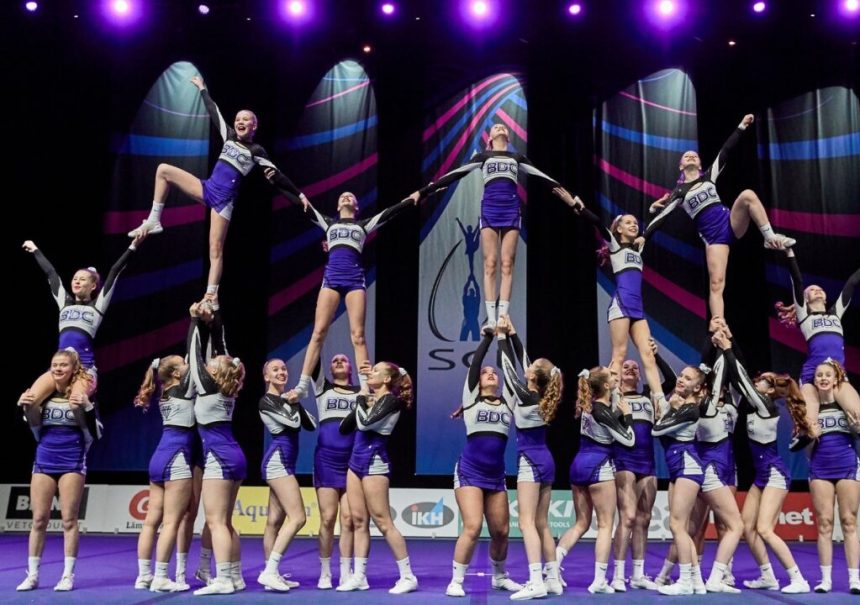
Athletes sprint into tumbling passes, lift teammates above their heads, execute synchronized jumps, build multi-level pyramids, and complete choreographed routines in which every movement must happen at exactly the right moment.
There is little room for hesitation.
A missed grip, late count, unstable landing, or formation error can affect an entire routine. Success requires strength, flexibility, balance, trust, endurance, performance ability, and extraordinary attention to detail.
School cheer also continues to play an important role in leading crowds and supporting athletic programs. Competitive cheerleading takes many of those foundational skills and places them into a scored athletic environment built around execution, difficulty, synchronization, and safety.
The result is one of the most demanding and visually exciting activities in high school sports.
By the Numbers
- Athletes Worldwide: Approximately 10 million across cheer disciplines
- International Governing Body: International Cheer Union
- ICU Member Federations: More than 120 national cheer federations
- Typical Competition Routine: Approximately 2½ minutes, depending on the division and event
- Core Skills: Stunting, tumbling, jumps, pyramids, dance, motions, and crowd-leading
- Primary Pathways: School cheer, recreational cheer, all-star cheer, collegiate cheer, performance cheer, and STUNT
- Global Status: Recognized internationally through national federations and global championships
The International Cheer Union describes itself as the recognized world governing body for cheer and reports a global community of approximately 10 million athletes across its member federations.
What Is Competitive Cheerleading?
Competitive cheerleading is a judged team activity in which athletes perform a choreographed routine containing a combination of athletic and performance elements.
A routine may include:
- Standing and running tumbling
- Partner stunts
- Group stunts
- Basket tosses
- Pyramids
- Jumps
- Dance
- Motions
- Transitions
- Crowd-leading elements
- Synchronized formations
Teams compete within divisions determined by factors such as age, school classification, team size, skill level, and competition format.
Judges evaluate categories that may include:
- Difficulty
- Execution
- Synchronization
- Technique
- Creativity
- Formations
- Transitions
- Overall impression
- Safety and rule compliance
The challenge is not merely performing difficult skills. Teams must perform those skills cleanly, confidently, and together.
School Cheer and Competitive Cheer Are Connected—but Different
High school cheer programs often serve two important functions.
The first is traditional school spirit. Athletes lead crowds, perform at pep rallies, support other athletic teams, and represent their schools at community events.
The second is competition. Teams prepare structured routines and compete against other schools under established rules and scoring systems.
USA Cheer describes school cheer as a scholastic discipline that commonly supports football, basketball, pep rallies, and broader school spirit. Competitive programs add a formal performance and judging component to that role.
Some athletes also participate in all-star cheer, which operates through independent gyms rather than school teams. All-star cheer generally focuses more exclusively on competition and may use different divisions, levels, rules, and seasonal structures.
Both pathways can develop high-level athletes, but families should understand the differences in schedules, travel, costs, coaching structures, and program expectations.
The Athletic Demands of Competitive Cheerleading
Competitive cheer requires athletes to combine several physical disciplines within one routine.
Strength
Bases and back spots must generate and control force while lifting, catching, and stabilizing teammates.
Flyers also need considerable strength. Holding body positions above the ground requires core control, balance, flexibility, and the ability to remain tight while other athletes move beneath them.
Explosive Power
Tumbling, jumps, tosses, and stunt entries depend on rapid force production. Athletes repeatedly accelerate, jump, rotate, and absorb impact.
Flexibility
Many body positions require significant hip, leg, shoulder, and back flexibility. Flexibility must be developed carefully because range of motion without strength or control can increase injury risk.
Endurance
A competition routine may be relatively short, but it demands near-continuous high-intensity effort. Athletes must preserve technique and timing even as fatigue increases.
Timing and Spatial Awareness
Cheerleading is performed in close proximity to teammates. Athletes must know where others are positioned and react immediately when a stunt changes, a landing moves, or a teammate needs support.
Did You Know?
The International Olympic Committee granted full recognition to the International Cheer Union in 2021.
That recognition did not automatically place cheerleading on the Olympic competition program, but it represented an important milestone in the sport’s international development and governance.
Why Trust Is a Competitive Skill
Few team sports depend on trust as visibly as competitive cheerleading.
Flyers must trust their bases and back spots to provide stable support. Bases must trust one another to lift and catch with synchronized timing. Tumblers must know that the performance surface is clear. Every athlete must remain committed to the count and the technique being performed.
Communication often happens through:
- Verbal counts
- Eye contact
- Hand positioning
- Body tension
- Rehearsed corrections
- Immediate safety reactions
The strongest teams are not simply collections of talented individuals. They are systems in which athletes understand their responsibilities and protect one another.
That is one reason competitive cheer can become such a powerful environment for developing leadership, accountability, confidence, and teamwork.
Safety, Coaching, and Responsible Progression
Competitive cheerleading involves elevated stunts, tumbling, catches, and repeated impact. Proper instruction and progressive skill development are essential.
In the United States, the National Federation of State High School Associations publishes spirit rules designed for high school programs, while USA Cheer provides safety education, rules guidance, training, and certification resources.
The NFHS and USA Cheer update high school rules as techniques, equipment, and safety knowledge evolve.
Families evaluating a program should look for:
- Coaches with recognized safety training
- Age-appropriate skill progression
- Proper spotting
- Emergency action plans
- Concussion awareness
- Appropriate performance surfaces
- Clear return-to-play procedures
- Background screening and athlete protection policies
- A culture in which athletes can report pain, fear, or unsafe conditions
Athletes should not be rushed into advanced skills simply to increase routine difficulty.
Clean execution of appropriate skills is more valuable than unsafe attempts at skills a team is not ready to perform.
The High School Cheerleading Experience
High school cheerleading can require a significant commitment.
Depending on the program, athletes may participate in:
- Summer camps
- Preseason conditioning
- Football games
- Basketball games
- Pep rallies
- Community appearances
- Competition practices
- Regional championships
- State championships
- National events
This makes cheer unusual within school athletics. Athletes may support other programs throughout multiple seasons while also preparing for their own competitive schedule.
The experience can teach:
- Time management
- Public speaking
- School leadership
- Performance under pressure
- Team accountability
- Community involvement
- Physical discipline
The NFHS represents state high school associations serving approximately 19,500 schools, making it an important starting point for understanding scholastic sports structures and participation.
The College Pathway
College cheerleading exists in several forms.
Some programs primarily support university athletic teams. Others also compete at major national championships. Program structures, funding, recruiting processes, scholarships, and varsity recognition differ substantially between institutions.
Prospective college cheerleaders should research:
- Required tumbling skills
- Stunting expectations
- Coed or all-girl formats
- Tryout procedures
- Game-day responsibilities
- Competition schedules
- Scholarship availability
- Academic requirements
- Strength and conditioning support
- Medical and athletic training resources
A strong high school or all-star background can prepare athletes for collegiate cheer, but recruiting is not standardized in the same way as many NCAA championship sports.
Athletes should communicate directly with college programs and verify all requirements through official university channels.
STUNT: A Related Competition Format
STUNT is a team sport developed from traditional cheerleading skills.
Instead of presenting one continuous choreographed routine, teams compete head-to-head in structured rounds involving:
- Partner stunts
- Pyramids and tosses
- Jumps and tumbling
- Team routines
The format is designed to make direct competition and scoring easier for spectators to follow.
STUNT should not be treated as identical to traditional school cheer or all-star cheer, but it provides another competitive pathway for athletes with cheerleading skills.
The Global Growth of Cheer
Although modern cheerleading developed largely within the United States, it is now practiced internationally.
The International Cheer Union oversees global disciplines and works with national federations across the Americas, Europe, Asia, Africa, and Oceania.
Its major events include:
- ICU World Cheerleading Championships
- ICU Junior World Cheerleading Championships
- Continental championships
- National team competitions
- Performance cheer events
- Coaching and judging education programs
International growth has expanded the sport beyond its traditional image. National teams now compete in multiple disciplines, and countries are creating their own coaching systems, championships, and athlete-development pathways.
Major Competitive Cheerleading Events
UCA National High School Cheerleading Championship
Organized through Universal Cheerleaders Association, this event brings leading school cheer programs together for national competition.
NCA High School Nationals
The National Cheerleaders Association hosts major school and all-star competitions with divisions covering different team formats and skill structures.
ICU World Cheerleading Championships
The International Cheer Union stages international competition for national teams representing member federations.
State Championships
Many state high school associations conduct their own sanctioned championships. Rules, qualifying systems, divisions, and season dates vary by state.
All-Star Cheer Championships
Independent gyms compete through a broad system of regional, national, and international events. Families should verify the governing rules, event producer, division requirements, and qualification process before entering a program.
The Business of Competitive Cheerleading
Competitive cheerleading supports a substantial ecosystem involving uniforms, footwear, training facilities, camps, choreography, event production, media, travel, safety education, and specialized equipment.
Varsity Spirit
Varsity Spirit operates camps, competitions, educational programs, apparel services, and major event brands including UCA and NCA. Its platform also provides resources for school coaches, all-star programs, athletes, and families.
Nfinity
Nfinity specializes in cheer footwear, backpacks, uniforms, and performance apparel designed for the demands of stunting, tumbling, practice, and competition.
Rebel Athletic
Rebel Athletic produces cheer uniforms, practice wear, footwear, accessories, and customized team apparel for school and all-star programs.
GK Elite
GK Elite provides uniforms and performance apparel for cheerleading and gymnastics, including all-star cheer collections and teamwear.
Omni Cheer
Omni Cheer supplies uniforms, shoes, pom accessories, warmups, practice wear, and team packages for school and recreational cheer programs.
Dollamur Sport Surfaces
Dollamur manufactures athletic flooring and mat systems used in cheerleading, gymnastics, martial arts, wrestling, and other training environments.
Spieth America
Spieth America produces gymnastics and cheer training equipment, including mats and surfaces used for skill development and facility safety.
These businesses demonstrate why competitive cheer is more than a school activity. It supports a specialized market connecting athletes, coaches, schools, gyms, event operators, apparel companies, media platforms, and training facilities.
What Equipment Do Cheerleaders Need?
Equipment requirements depend on whether an athlete participates in school cheer, all-star cheer, recreational cheer, or STUNT.
Common needs include:
- Cheer shoes
- Practice apparel
- Competition uniform
- Warmups
- Hair accessories
- Team bag
- Athletic tape
- Braces or supports when medically recommended
- Water bottle
- School-approved sideline accessories
- Properly maintained cheer mats for training
Cheer shoes are generally designed to be lightweight and responsive while providing support for jumping, tumbling, and stunting.
Athletes should follow their coach’s requirements rather than purchasing specialized footwear or protective equipment without guidance.
How to Choose a Cheerleading Program
A strong program should be judged by more than trophies.
Parents and athletes should ask:
- Are the coaches properly trained?
- How are new skills introduced?
- What happens when an athlete is injured?
- Are practices conducted on appropriate surfaces?
- Are athletes encouraged to communicate concerns?
- What are the total seasonal costs?
- How much travel is expected?
- Is the program school-based, recreational, or all-star?
- What competition rules does the team follow?
- Are expectations compatible with school and family responsibilities?
Warning signs may include:
- Pressure to perform unsafe skills
- Inadequate spotting
- Unclear financial commitments
- No visible safety plan
- Coaches dismissing injuries
- Athletes being encouraged to hide pain
- Promises of guaranteed scholarships
- Excessive emphasis on appearance or weight
- A culture built on fear rather than instruction
The best program is not necessarily the one with the most difficult routine. It is the one that develops athletes responsibly and gives them a positive reason to return.
Watch Competitive Cheerleading in Action
International Cheer Union
Watch international national-team performances, championship routines, and highlights from the global cheer community.
Varsity Spirit
Features school cheer, all-star cheer, competition highlights, athlete stories, and educational content.
USA Cheer
Provides information related to national teams, athlete development, safety, and sport-cheer programs in the United States.
NFHS Network
Streams high school sports and activities from participating state associations and schools. Availability for cheer competitions varies by event and location.
Explore the Sport
USA Cheer
The U.S. governing organization for sport cheering, with resources covering safety, education, national teams, rules, membership, and athlete protection.
International Cheer Union
The recognized international governing body for cheer, representing national federations and organizing international championships.
National Federation of State High School Associations
Develops high school sports and activity rules and supports state athletic associations throughout the United States.
USA Cheer High School Resources
Information specifically focused on scholastic cheer, including the role of school cheerleaders, rules, education, and athlete development.
NFHS Spirit Rules
Official information concerning NFHS spirit rules publications for high school programs.
Varsity Spirit
Information about camps, competitions, educational resources, school cheer, all-star cheer, and event brands.
STUNT
The official resource for the head-to-head team sport developed from cheerleading skills.
Global Sports Market Index
| Category | Rating |
|---|---|
| Youth Participation | 9.5/10 |
| High School Presence | 9.5/10 |
| Global Reach | 8.5/10 |
| Technical Skill | 9.5/10 |
| Athletic Demand | 9.5/10 |
| Teamwork and Trust | 10/10 |
| Spectator Appeal | 9/10 |
| Business Ecosystem | 9.5/10 |
| College Pathway | 8/10 |
| Accessibility | 7.5/10 |
Overall Global Sports Market Intelligence Rating: 91/100
Global Sports Market Verdict
Competitive cheerleading deserves to be understood as a serious athletic discipline.
Its athletes combine the explosive power of gymnastics, the synchronization of dance, the strength of partner acrobatics, and the trust of a tightly connected team.
The sport also occupies an unusual place within high school culture. Cheerleaders may support an entire athletic department while simultaneously training for their own competition season.
That dual role requires commitment, leadership, resilience, and considerable physical ability.
Competitive cheer is not defined by a single stunt or performance. It is built through thousands of repetitions, careful progressions, precise counts, and athletes learning to depend on one another.
Final Thoughts
Competitive cheerleading has grown far beyond the outdated idea that cheerleaders simply stand on the sidelines.
Modern athletes tumble, jump, lift, catch, balance, perform, and compete under intense pressure.
They must be powerful without losing control, expressive without losing precision, and fearless without ignoring safety.
For high school students, competitive cheer can create lasting friendships, school pride, leadership opportunities, and a demanding athletic challenge.
For spectators, it offers fast-paced routines in which strength, risk, creativity, and teamwork come together in just a few unforgettable minutes.
Continue Your Discovery
Competitive cheerleading shares athletic qualities with team sports that demand synchronization, agility, communication, and trust. Continue exploring these published reports from theGLOBALSPORTSMARKET.com:
- Field Hockey Explained: Why Millions Around the World Love the Game — Another major high school and college sport built around communication, conditioning, and total team commitment.
- Why Floorball Matters: The Fast-Paced Global Sport Most Fans Have Never Discovered — Explore a fast indoor team sport requiring constant movement, coordination, and quick decision-making.
- Discover Futsal: The Indoor Game That Created Football’s Greatest Stars — Learn how a compact playing environment develops speed, creativity, footwork, and rapid reactions.
- Beyond the Basement: Why Table Tennis Is One of the World’s Biggest Sports — Discover another sport in which timing, body control, repetition, and split-second precision determine success.
- Field Hockey Explained: Why Millions Around the World Love the Game — Follow the pathway from school participation to college and international competition in one of the world’s major team sports.
Join the Global Sports Community
At theGLOBALSPORTSMARKET.com, we explore the sports that shape schools, communities, cultures, and international competition.
From traditional varsity programs to emerging global disciplines, our goal is to help athletes, parents, coaches, and fans understand how each sport works—and where the journey can lead next.
Explore more sports. Find trusted resources. Keep discovering the games that connect the world.

Author: theHowie
We are building a network of digital resources designed to bring some much-needed order to the internet's most chaotic corners. I don't just collect domains; I build them into authoritative hubs for the topics I’m passionate about.