

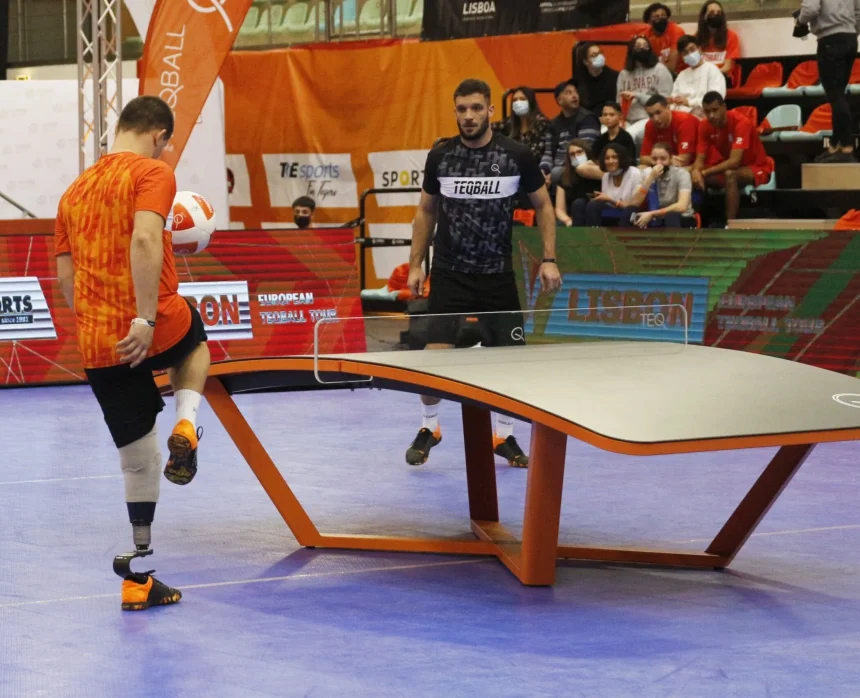
Teqball is a rapidly emerging precision and skill-based sport played on a curved table, combining elements of football (soccer) with table-based rebound mechanics. Players use any part of the body except the hands and arms to return a football across a specially designed table, with the objective of forcing an error from the opponent. The curved surface standardizes ball trajectory and encourages continuous play, technical control, and quick decision-making.
Core physical demands include balance, coordination, lower-body dexterity, spatial awareness, reaction speed, and fine motor control. Unlike traditional football, teqball emphasizes ball mastery in confined space, repeated technical execution, and controlled touch rather than open-field sprinting.
Teqball is played in singles and doubles formats. Mixed doubles competition is also structured at international events. The sport is primarily indoor but can be played outdoors on stable surfaces. It is governed internationally by the International Teqball Federation (FITEQ) and has expanded across Europe, Asia, Africa, and the Americas. The sport has gained visibility through world championships and multi-sport events, with ongoing efforts toward broader international recognition.
From 2025–2026, participation growth is strongest in countries with established football cultures. Teqball tables are increasingly installed in clubs, academies, schools, and training facilities as a supplemental technical development tool. The sport also functions as an off-field skill training method for football players.
Technology adoption includes performance tracking through video analysis, table-standard manufacturing compliance, and structured competition scoring systems. Safety evolution has focused on stable table installation and controlled playing environments.
Section 3: How We Can Help
theglobalsportsmarket.com provides structured guidance for athletes, families, and coaches navigating teqball participation and development pathways. The platform clarifies differences between recreational table play and sanctioned competition, outlines progression models, and explains governing body affiliation requirements.
Support includes education on equipment standards, table compliance specifications, and competition formats. The platform also highlights how teqball integrates into broader football development programs as a technical skill enhancement tool.
Community-based discovery of verified clubs, academies, and structured programs is supported through Meet:
https://meet.theglobalsportsmarket.com
Section 4: Governing Organizations
International Teqball Federation (FITEQ) – https://www.fiteq.org
Teqball USA – https://www.teqballusa.org
International Olympic Committee (IOC) – https://www.olympics.com
Section 5: Equipment Needed
Core Equipment (Youth → Pro)
Teqball Table: Official curved competition table manufactured to FITEQ standards
Football: Regulation size ball appropriate to age classification
Indoor Court Surface: Stable, level surface meeting safety requirements
Safety & Certification
Official competition tables must meet International Teqball Federation specifications regarding curvature, stability, and surface material. Organized events should operate under national federation governance where applicable.
2025–2026 Technology Trends
Video-based skill analysis for ball control and reaction speed
Standardized table engineering to ensure consistent rebound
Integration into football academies as technical development training
Section 6: Major Global Events
Professional / Elite
Teqball World Championships – https://www.fiteq.org
Teqball World Series – https://www.fiteq.org
Amateur & Youth
National championships organized by FITEQ member federations
Regional development tournaments coordinated through national associations
Section 7: Local Amateur Clubs
How to Identify Legitimate Programs
As teqball continues to expand, families and athletes should confirm:
• Affiliation with a recognized national teqball federation
• Use of certified competition tables
• Structured coaching oversight
• Clear safety policies and supervised play
• Age-appropriate development pathways
Development Pathway Explanation
Recreational Play
Community or academy-based table access focused on ball control and technical skill.
Competitive Club Level
Sanctioned tournaments and structured ranking pathways.
Elite Pathway
National team selection, international tournaments, and world championship qualification.
Seasonal Commitment Expectations
Teqball can operate year-round indoors, often complementing football training schedules.
Cost Transparency Expectations
Participation may include table access fees, coaching costs, and tournament entry fees.
Red Flags to Avoid
• Use of non-regulation or unstable equipment
• No federation affiliation
• Lack of structured supervision
• Overstated claims of professional exposure
Official Governing Body Club Finders
International Teqball Federation – Member Federations – https://www.fiteq.org
Teqball USA – https://www.teqballusa.org
Youth & Competitive Directories
Participants researching competition results and rankings may consult:
FITEQ World Rankings – https://www.fiteq.org
National federation event listings
These resources provide competition visibility but should not replace evaluation of coaching structure and safe facility standards.
Community-Based Discovery
Additional structured community discovery and local program evaluation can be supported through:
https://meet.theglobalsportsmarket.com
Careful evaluation of local amateur teqball programs ensures safe participation, structured progression, and alignment with long-term athletic development goals.